AI is not going to take your job. But the entrepreneur next door who uses AI to do in 2 hours what takes you 20? They are going to eat your lunch.
Let me be direct: AI will not replace you as an entrepreneur, coach, or consultant. But someone using AI absolutely will. That is not a threat — it is a reality check. According to McKinsey's 2025 State of AI report, businesses that have adopted AI automation are seeing 20 to 30 percent productivity gains across operations. If your competitor is using AI and you are not, you are already behind.
I spent a decade in Nepal after losing everything in 2008. When I came back to the business world, I did not have the luxury of building slowly. I had to find leverage — ways to do more with less. AI automation became the single biggest lever I found. Today, through our AI automation services, I help entrepreneurs install the same systems that let me rebuild from zero.
The AI Reality Check for Entrepreneurs
Most entrepreneurs fall into one of two camps when it comes to AI. Camp one: they are terrified, convinced AI will make them obsolete. Camp two: they are ignoring it entirely, hoping it is a fad. Both camps are wrong.
AI is a tool. Like a tractor replaced the ox plow, AI replaces manual cognitive labor — the repetitive, time-consuming tasks that eat up your day. Data entry. Email responses. Content drafting. Lead scoring. Appointment scheduling. Social media posting. Report generation.
These tasks need to get done, but they do not need you to do them. Every hour you spend on a task AI can handle is an hour stolen from high-value work: strategy, relationships, creative problem solving, and leadership.
What AI Actually Replaces (And What It Cannot)
Here is the distinction that matters: AI replaces tasks, not people. Specifically, AI excels at:

- Pattern recognition: Analyzing data, identifying trends, scoring leads
- Content generation: First drafts, outlines, summaries, social posts
- Process automation: Scheduling, follow-ups, data entry, reporting
- Research: Market analysis, competitor monitoring, trend tracking
What AI cannot replace:
- Strategic judgment: Deciding which market to enter, which clients to pursue
- Relationship building: Trust, empathy, genuine human connection
- Creative vision: Original ideas, brand positioning, thought leadership
- Leadership: Inspiring teams, making tough calls, navigating ambiguity
The entrepreneurs who win are the ones who offload the first list to AI and double down on the second list. That is not replacement — it is amplification. According to Harvard Business Review, executives who use AI as an amplification tool see 40 percent more time available for strategic work.
Five AI Quick Wins You Can Implement This Week
You do not need a six-month AI transformation project. Start with these five quick wins:
- Email triage and response: Use AI to categorize incoming emails by priority and draft responses. You review and send. Time saved: 5 to 8 hours per week.
- Content repurposing: Feed your YouTube transcript into AI to generate blog posts, social media posts, and email newsletters. Time saved: 10 to 15 hours per week. (See my Authority Flywheel post for the full system.)
- Lead qualification: Set up AI to score incoming leads based on criteria you define — budget, timeline, fit. Time saved: 3 to 5 hours per week.
- Meeting preparation: AI can research prospects before calls, pulling relevant data from LinkedIn, their website, and public information. Time saved: 2 to 3 hours per week.
- Social media scheduling: AI generates a week of social posts from your content library, you approve in batch. Time saved: 4 to 6 hours per week.
Total potential time saved: 24 to 37 hours per week. That is almost a full additional workweek recovered.
The AI Automation Stack I Recommend
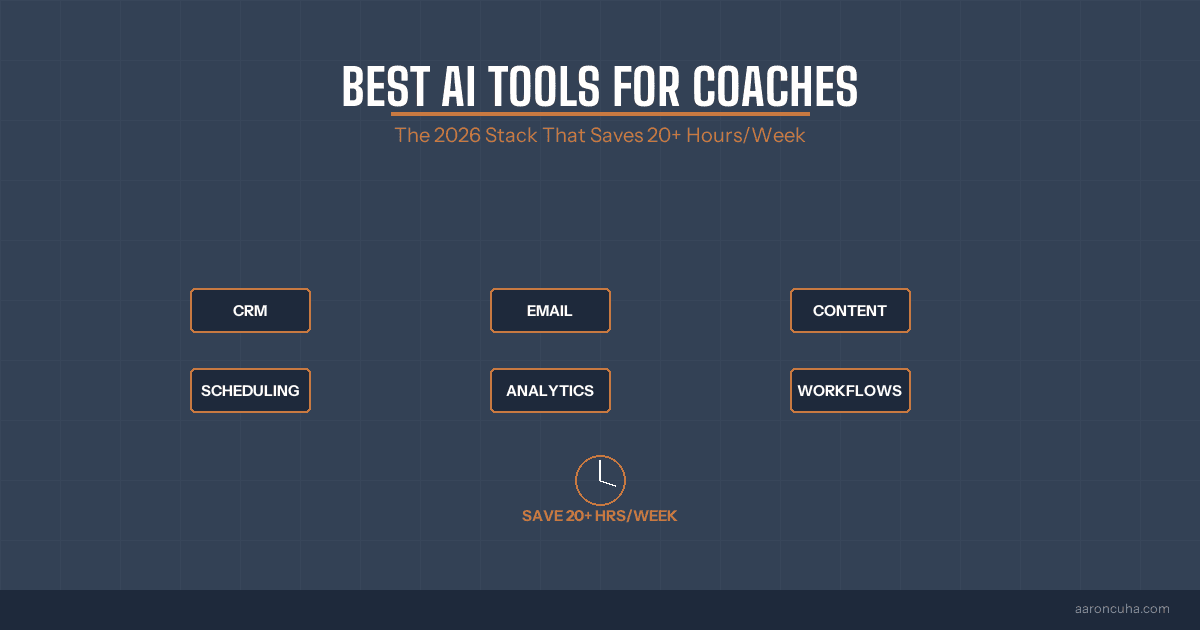
After testing dozens of AI tools with hundreds of clients, here is the stack that delivers the highest ROI for coaches, consultants, and service-based businesses:
- CRM layer: AI-enhanced CRM that scores leads and triggers follow-up sequences automatically
- Content layer: AI writing and video tools that handle repurposing (connected to your YouTube channel)
- Communication layer: AI email and chat assistants that handle routine inquiries
- Analytics layer: AI dashboards that surface insights instead of raw data
- Workflow layer: Automation platforms that connect everything and eliminate manual handoffs
The key is integration. Individual AI tools are useful. An integrated AI automation stack is transformative. That is what we build for clients through our AI systems service — not just individual tools, but a connected ecosystem.
Three Mistakes Entrepreneurs Make with AI
I have seen enough AI implementations fail to know the common patterns:
Mistake 1: Starting too big. Do not try to automate everything at once. Pick one workflow, automate it, prove the ROI, then expand. The entrepreneurs in my Systems Over Hustle community who succeed with AI always start with a single use case.
Mistake 2: No human oversight. AI is powerful but imperfect. Every AI output needs a human review layer, especially for client-facing content and communication. Set up approval workflows, not fully autonomous systems.
Mistake 3: Ignoring the team. Your team needs training and buy-in. AI adoption fails when it is imposed top-down without explaining the "why" and providing hands-on training. Invest in your people as much as your tools. If you need help with this transition, our executive coaching includes AI adoption leadership.
AI as a Competitive Advantage
Here is the bottom line: AI is not optional anymore. It is a competitive necessity. Forbes reports that 75 percent of businesses plan to increase AI spending in 2026. If you are not in that 75 percent, you are in the 25 percent that will be outcompeted.
But the advantage is not in the tools themselves. Everyone has access to the same tools. The advantage is in how you implement them — the systems, workflows, and integrations that turn individual AI capabilities into a compounding business machine.
That is what I mean by "Systems Over Hustle." AI is the ultimate system. It does not get tired, does not call in sick, and does not need motivation. But it does need strategy, architecture, and human judgment to deploy effectively.
The Future Belongs to AI-Augmented Entrepreneurs
AI will not replace you. But someone using AI will replace you if you do not adapt. The good news? The barrier to entry has never been lower. You do not need a technical team. You do not need a massive budget. You need a clear understanding of what to automate, the right tools, and a system for implementation.
Start with the five quick wins I outlined above. Then, when you are ready to build a full AI automation stack, book a strategy call and I will personally walk you through the blueprint. Or grab a copy of Crazy Simple YouTube to see how AI fits into the content creation process specifically.
Frequently Asked Questions
Will AI replace coaches and consultants?
No. AI cannot replicate the trust, empathy, and strategic judgment that human coaches provide. It will replace the administrative and operational tasks that consume your time, freeing you to do more of the high-value work that clients pay for.
How much does it cost to implement AI automation?
Basic AI automation can be set up for under $200 per month in tool costs. A full enterprise-grade stack typically runs $500 to $2,000 per month. The ROI usually pays for itself within the first month through time savings alone.
Do I need technical skills to use AI tools?
No. Modern AI tools are designed for non-technical users. If you can use email and social media, you can use AI tools. The setup and integration is where expertise helps, which is why we offer done-for-you implementation.
What is the biggest risk of not adopting AI?
Falling behind competitors who are operating at 2x to 3x your efficiency. In fast-moving markets, that gap compounds quickly and becomes impossible to close.
How do I know which AI tools to choose?
Start with the problem, not the tool. Identify your biggest time drain, then find the AI tool that addresses it specifically. Avoid shiny object syndrome — one well-implemented tool beats ten unused subscriptions.

Written by
Aaron CuhaAuthor of Crazy Simple YouTube, keynote speaker, and executive coach with 20,000+ hours logged. ICF PCC, NLP Master Practitioner, and DISC Certified. Aaron helps entrepreneurs replace hustle with AI-powered systems that generate leads, content, and revenue on autopilot.