Hustle is a starting strategy, not a scaling strategy. Here is the 4-pillar framework — content systems, lead systems, delivery systems, and automation — that lets you build once and scale forever.
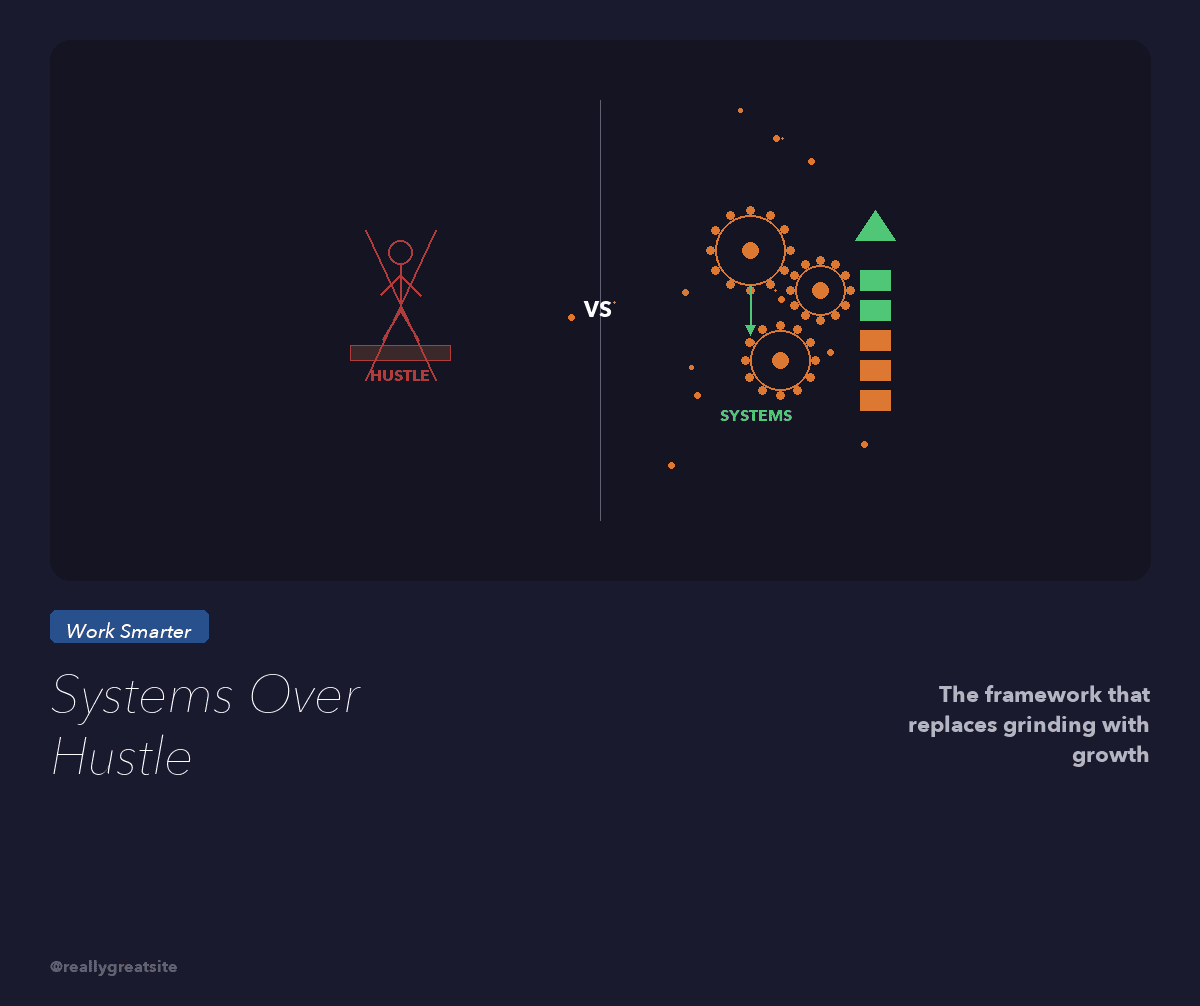
The Systems Over Hustle framework is the operating philosophy behind everything I build, teach, and coach. After scaling a mortgage company to 280 offices with more than 3,000 employees, launching multiple seven-figure coaching businesses, and helping hundreds of entrepreneurs escape the grind, I can tell you one thing with absolute certainty: hustle is a starting strategy, not a scaling strategy. The entrepreneurs who win long-term are not the ones who work the most hours. They are the ones who build the best systems.
A Harvard Business Review study found that 74 percent of businesses that fail to scale cite "founder dependency" as a primary factor. Translation: the business cannot run without the founder doing everything. That is not a business. That is a job with extra stress. The Systems Over Hustle framework solves this by building four pillars that operate independently of your daily effort.
Key Takeaways
- The 4 pillars — content systems, lead systems, delivery systems, and automation — work together as a compounding engine. Remove one and the others underperform.
- A documented content system reduces production time by 60 percent and increases output by 3 times.
- Lead systems that run on autopilot generate 40 to 100 leads per month without daily hustle.
- Delivery systems are the most neglected pillar. Without them, you scale revenue but also scale chaos.
- Automation is not about replacing humans. It is about freeing humans to do the work that actually requires a human.
Ready to replace hustle with systems? Let me walk you through exactly how to build each pillar for your business.
Book a Strategy SessionWhy Hustle Breaks at Scale
Hustle works when you are starting from zero. You have no audience, no reputation, no pipeline. You have to grind to create momentum. I respect that season. I have lived it multiple times. But here is what nobody tells you: the habits that got you from zero to $100K will destroy you from $100K to $1M.
When you are the person filming every video, answering every DM, running every sales call, delivering every coaching session, and managing every client relationship — you hit a ceiling. That ceiling is your time. No amount of willpower adds a 25th hour to the day. According to Gallup, 76 percent of entrepreneurs experience burnout. Not because they are lazy. Because they are doing too much of the wrong work.
The fix is not "work harder" or "wake up at 4 AM." The fix is systems. Documented, repeatable, delegatable systems that produce results whether you are at your desk or on a beach in Cabo. I teach these exact systems inside the Systems Over Hustle community, and the transformation I see is always the same: entrepreneurs go from 60-hour weeks to 25-hour weeks while doubling their revenue.
Pillar 1: Content Systems
Your content system is how you consistently create, publish, and distribute content without reinventing the wheel every week. Most entrepreneurs treat content creation like an art project — inspiration strikes, they create something, they post it, they wait. That is not a system. That is a hobby.
A real content system has five components:
- Ideation engine. A documented process for generating content ideas based on keyword research, audience questions, and competitor gaps. I use a rolling spreadsheet that my team and AI tools populate weekly. Zero brainstorming sessions required.
- Production workflow. A step-by-step checklist that takes a video from concept to published in under 4 hours. Script template, filming setup, editing process, thumbnail creation, SEO optimization — every step documented so anyone can execute it.
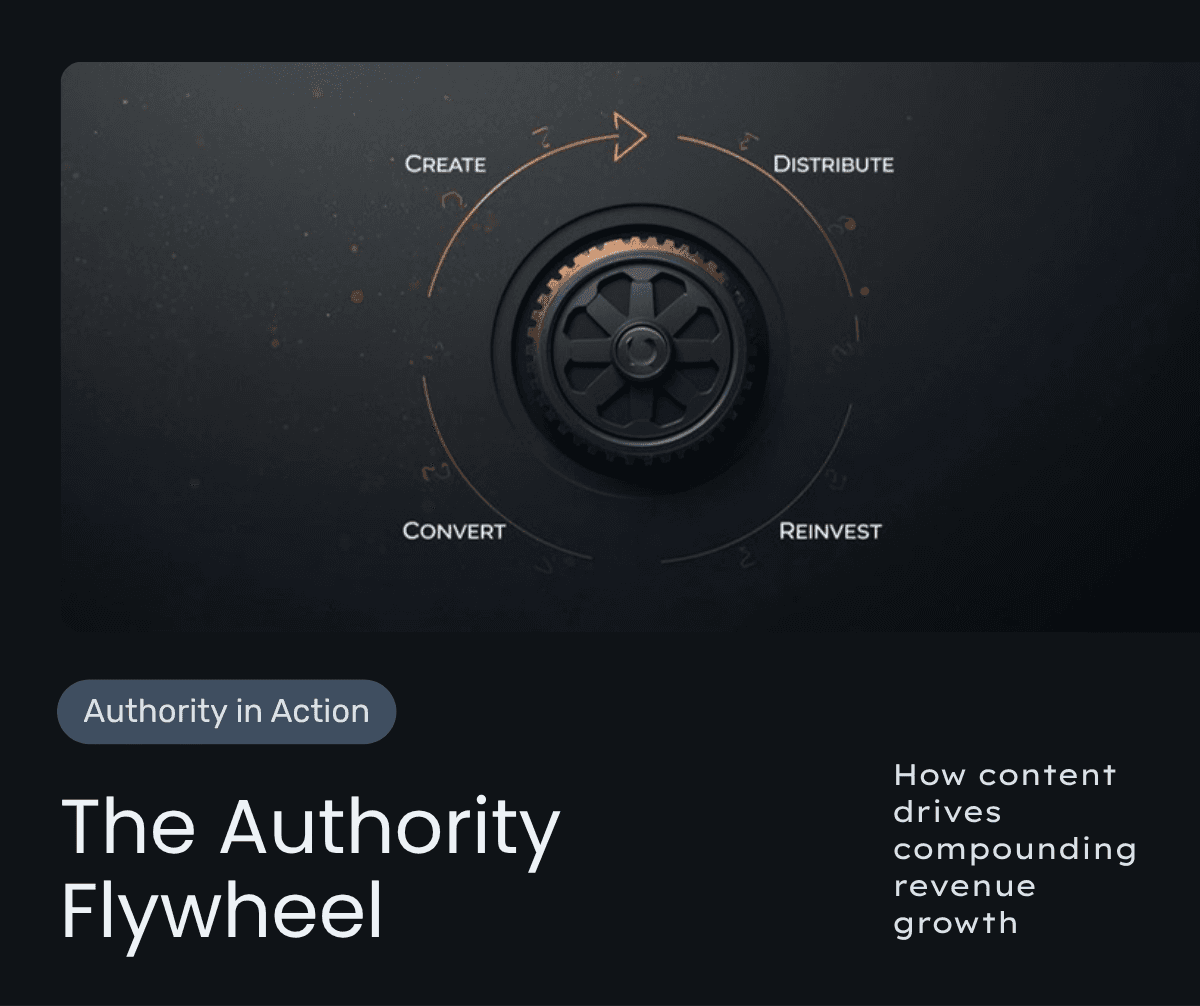
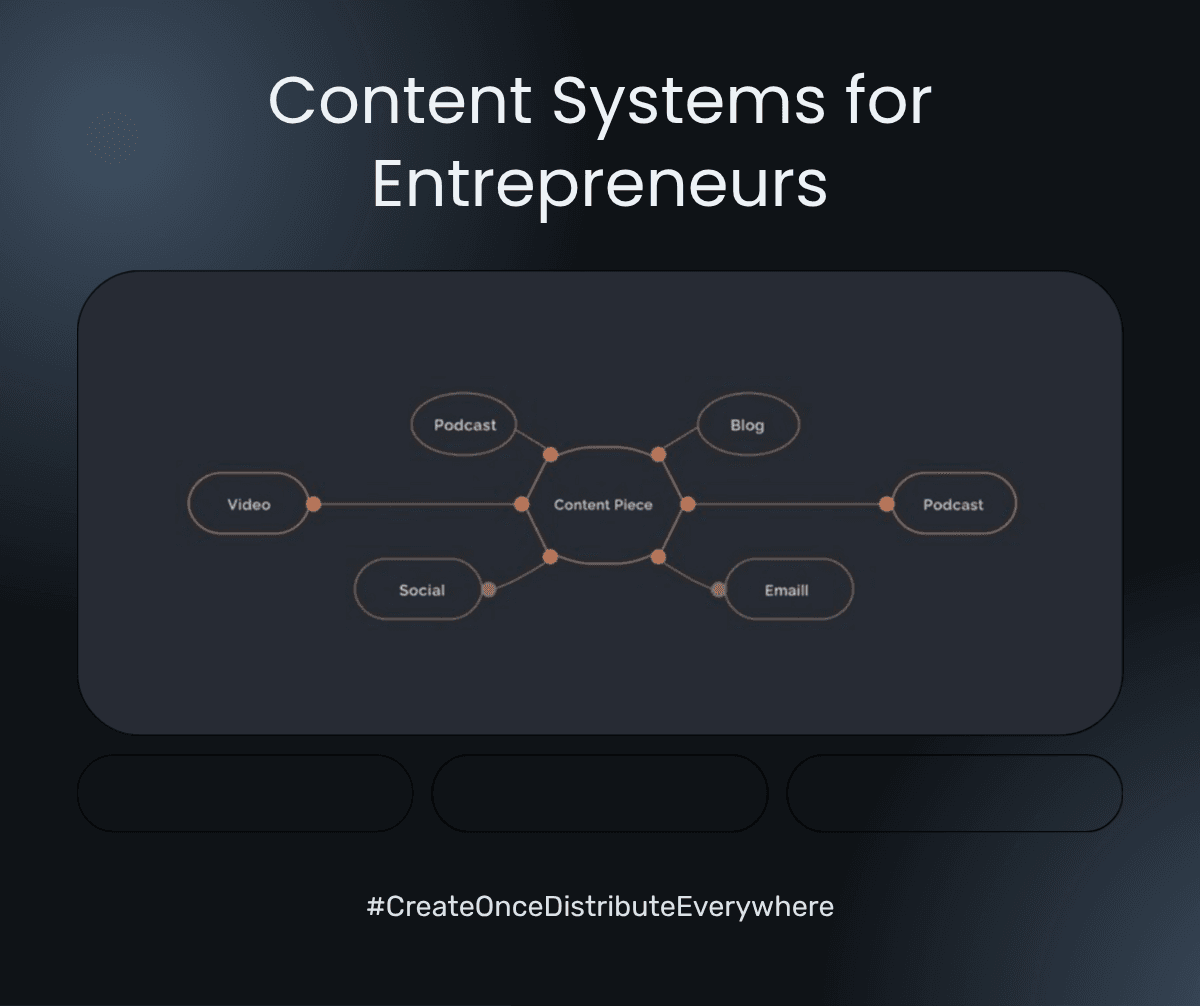
- Repurposing system. One long-form video becomes 30-plus pieces of content across every platform. I break this down fully in The Authority Flywheel. This is the highest-leverage activity in your content stack.
- Publishing calendar. Fixed days, fixed times, no negotiation. The algorithm rewards predictability and so does your team. When everyone knows Tuesday is publish day, there is no confusion and no missed deadlines.
- Performance review. A weekly 15-minute review of analytics. What worked, what did not, what to double down on. Data-driven decisions replace guesswork. My post on YouTube analytics covers the exact metrics to track.
When I implemented this exact content system for my own channels, my output went from 2 pieces of content per week to 15 — while my production time dropped from 20 hours to 8. That is not a marginal improvement. That is a 7.5 times increase in efficiency. The content system is the foundation of the framework because content drives everything else.

Pillar 2: Lead Systems
A lead system generates qualified prospects on autopilot. Not "I hope someone sees my post and DMs me." Actual, predictable, measurable lead flow. Here is the stack I teach inside executive coaching:
Inbound lead engine: YouTube content optimized for search brings in viewers who are already looking for what you sell. Each video points to a lead magnet — a PDF, checklist, free training, or assessment. The lead magnet captures their email. An automated nurture sequence builds trust over 7 to 14 days. A booking link converts warm leads into sales calls. This entire sequence runs 24/7 without you touching it.
Outbound assist layer: While inbound scales, outbound accelerates. A simple daily routine: 15 minutes engaging with your ideal clients on social media, 15 minutes sending personalized video messages to warm leads, 15 minutes following up with existing conversations. That is 45 minutes of focused outbound that fills your pipeline while your inbound engine compounds in the background.
Referral system: Every satisfied client should enter a documented referral workflow. A thank-you gift, a check-in call at 30 and 90 days, and a simple ask: "Who else do you know that might benefit from this?" Agents and coaches who systematize referrals see 30 to 40 percent of new business come from existing clients. Those who leave it to chance see 5 to 10 percent.
The difference between "I need more leads" and "I have more leads than I can handle" is not talent or luck. It is whether you have built a system or are winging it. For a deep dive into how YouTube specifically generates leads, see my post on YouTube lead generation strategy.
Pillar 3: Delivery Systems
This is the pillar everyone ignores — until it destroys them. You can have the best content in the world and a flood of leads, but if your delivery is chaos, your business will implode. I have watched six-figure businesses collapse because the founder scaled sales without scaling delivery. More clients plus the same messy fulfillment process equals angry clients, refund requests, and a destroyed reputation.
Delivery systems cover how you actually serve your clients:
- Onboarding workflow. From the moment someone pays to their first interaction with your service — every step is documented. Welcome email, intake form, calendar link, resource access, kickoff call template. A smooth onboarding experience sets the tone for the entire relationship. It should take you less than 10 minutes to onboard a new client because the system handles 90 percent of it.
- Service delivery framework. Whether you are coaching, consulting, or providing a service — you need a repeatable framework. Not "I wing it on every call." A structured 12-week curriculum. A step-by-step implementation plan. Milestones and check-ins at defined intervals. This is what I mean by "set in stone" — your delivery framework should be documented in a way that any competent team member could execute it. I wrote an entire book about this principle: Set in Stone.
- Quality control. Regular client satisfaction surveys, outcome tracking, and a feedback loop that identifies problems before they become fires. The best businesses do not just deliver — they measure the quality of their delivery and improve it constantly.
- Offboarding and retention. When a client finishes your program, what happens? Most entrepreneurs shrug and move on. A systemized offboarding includes a results review, testimonial request, referral ask, and upsell to the next tier. This single system can increase lifetime client value by 40 to 60 percent.
Every delivery system I build follows one rule: it should work at 10 times your current client volume without breaking. If you have 5 clients now, build delivery systems that could handle 50. That way, when growth comes — and it will — you are ready instead of scrambling.
Want help building delivery systems that scale? Inside executive coaching, I help you document every workflow so your business runs without you.
Book a Strategy SessionPillar 4: Automation
Automation is the accelerant that makes the other three pillars run faster. But here is the critical distinction: automation without systems is chaos at scale. You have to build the system first, then automate it. Most entrepreneurs try to automate a mess and wonder why everything breaks.
The automation stack I recommend for coaches and service providers:
- Email automation. Nurture sequences, onboarding emails, re-engagement campaigns, weekly content delivery. Once built, these run forever. A good email automation system replaces 5 to 10 hours per week of manual follow-up.
- Scheduling automation. Calendly or a similar tool with rules. Prospects can only book during defined windows. Buffer time between calls is automatic. Reminders and prep materials are sent without you thinking about it.
- Content distribution automation. One video publishes and triggers automatic distribution to social platforms, email list, and community. Tools like Zapier, Make, or custom AI workflows handle this. I cover the AI side in detail in my post on AI business systems automation.
- CRM automation. Lead scoring, pipeline stage updates, task creation, and follow-up reminders — all triggered by behavior, not by you remembering to do it. When a lead downloads your guide, the CRM tags them. When they open three emails in a row, the CRM flags them as hot. When they book a call, the CRM moves them to the next stage. Zero manual input.
- AI-powered workflows. AI is not the future of business automation — it is the present. I use AI agents to handle content repurposing, email drafting, client research, and data analysis. This is not about replacing your team. It is about giving every team member a tireless assistant. The results are staggering: tasks that used to take 2 hours now take 15 minutes. See my post on AI agents for coaches for the specific tools and workflows.
According to McKinsey, businesses that implement automation across their operations see an average productivity increase of 20 to 25 percent. In my experience with coaching clients, the number is closer to 40 percent because we are automating high-repetition, low-complexity tasks that eat the most time.
How to Build the Framework: The 90-Day Sprint
You do not build all four pillars simultaneously. That is a recipe for overwhelm. Here is the exact 90-day implementation plan I walk clients through in executive coaching:
Days 1 through 30: Content system. Document your ideation process, build your production workflow, create your first repurposing templates, and establish your publishing calendar. By day 30, you should be publishing consistently with half the effort it currently takes.
Days 31 through 60: Lead system. Build your lead magnets, set up your nurture sequences, create your booking funnel, and establish your outbound routine. By day 60, you should have a predictable lead flow that does not depend on you posting on social media every day.
Days 61 through 90: Delivery and automation. Document your onboarding, build your service framework, set up quality control, and layer automation across all three pillars. By day 90, your business should be running 70 percent on systems and 30 percent on your direct involvement — the exact inverse of where most entrepreneurs start.
This is not theory. I have run this sprint with more than 200 entrepreneurs inside our Systems Over Hustle community. The average result: a 45 percent reduction in working hours and a 60 percent increase in revenue within six months. Those numbers are not hypothetical. They are tracked, measured, and documented in our case studies.
Frequently Asked Questions
What is the Systems Over Hustle framework?
It is a 4-pillar business operating system: content systems, lead systems, delivery systems, and automation. Together, they allow you to build your business infrastructure once and scale it without proportionally increasing your time investment.
How long does it take to implement the framework?
The full 90-day sprint covers all four pillars. Most entrepreneurs see measurable results — reduced hours, increased leads, smoother delivery — within the first 30 days when they start with the content system.
Do I need a team to run these systems?
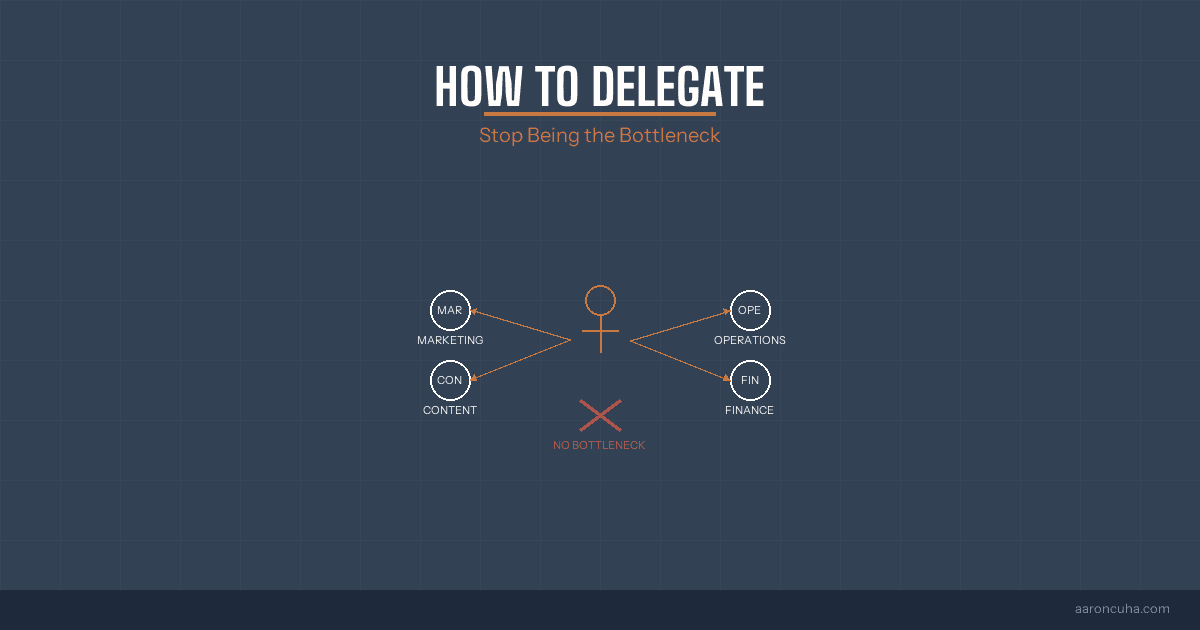
No. The framework is designed to work as a solopreneur first. AI tools and automation handle much of the execution. As you scale, you can delegate specific systems to team members using the documentation you have already built.
What if I am just starting my business?
Start with Pillar 1 (content system) and Pillar 2 (lead system). You need visibility and leads before you need complex delivery and automation. The framework scales with you — start simple and add layers as your revenue grows.
How is this different from other business frameworks?
Most frameworks tell you what to do. This framework tells you how to build the system that does it for you. The difference is sustainability. A tactic works until you stop doing it. A system works whether you show up today or not.
What tools do I need for the automation pillar?
At minimum: an email platform (ConvertKit or ActiveCampaign), a scheduling tool (Calendly), a CRM (GoHighLevel or HubSpot), and an AI assistant (Claude). Total cost: $200 to $400 per month. The ROI from saved time alone covers that within the first week.
Can this framework work for service businesses, not just coaches?
Absolutely. I have implemented this with real estate teams, law firms, financial advisors, SaaS companies, and e-commerce brands. The four pillars are universal. The specific systems within each pillar are customized to your business model.
What is the biggest mistake people make when building systems?
Trying to automate before documenting. You cannot automate a process that is not defined. Step one is always: write down what you do. Step two: optimize it. Step three: automate it. Skip to step three and you automate chaos.
Build the systems that set you free. Join the community where I teach this framework live every week.
Book a Strategy Session
Written by
Aaron CuhaAuthor of Crazy Simple YouTube, keynote speaker, and executive coach with 20,000+ hours logged. ICF PCC, NLP Master Practitioner, and DISC Certified. Aaron helps entrepreneurs replace hustle with AI-powered systems that generate leads, content, and revenue on autopilot.