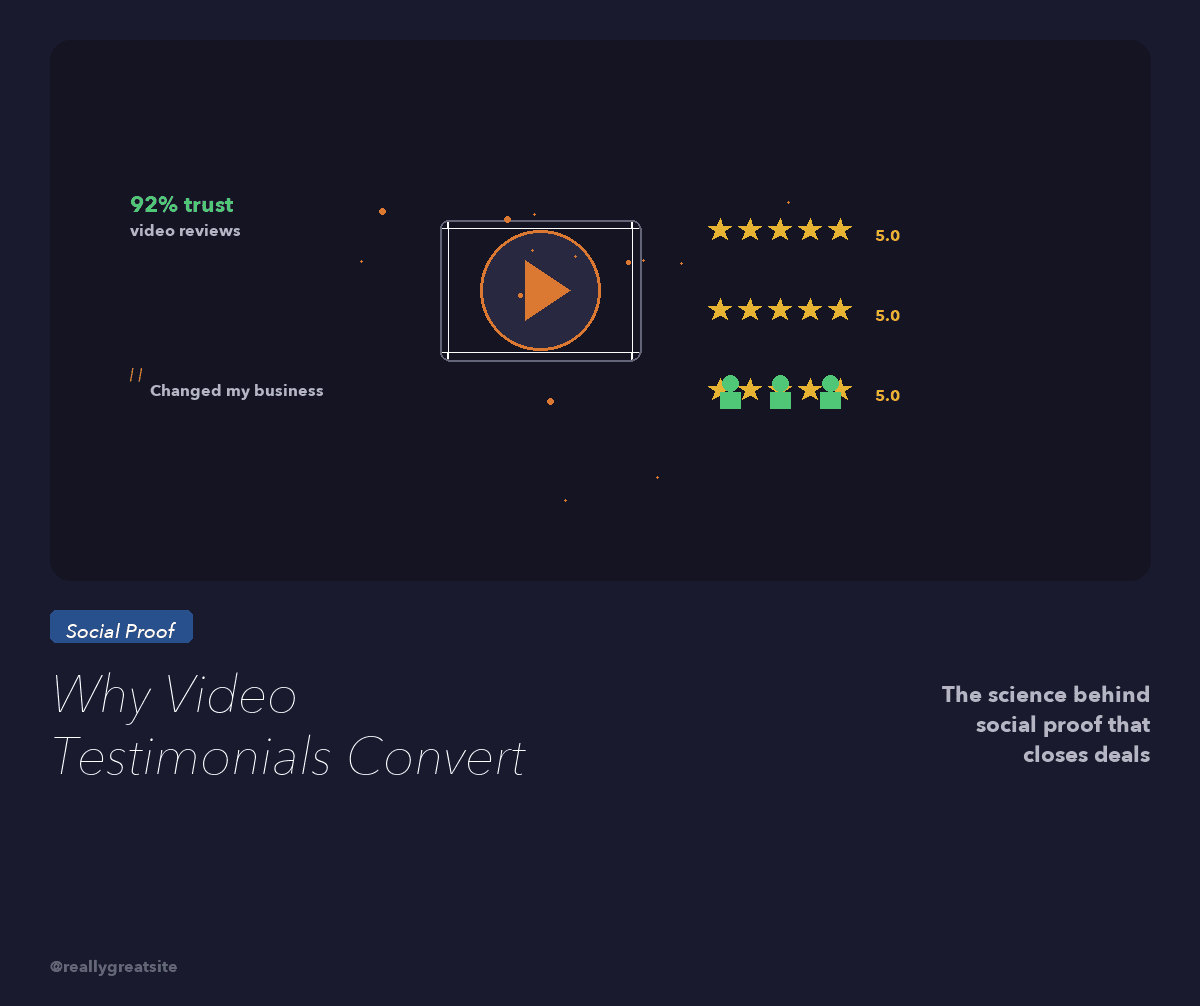
Text reviews are table stakes. Video testimonials convert 3x better because they trigger trust mechanisms that text cannot. Here is the complete system for getting, filming, and deploying video testimonials that close deals.
Video testimonials convert at rates that make every other form of social proof look amateur. After deploying video testimonial systems across more than 200 client businesses, I have seen the same pattern play out: pages with video testimonials convert 3 times better than pages with text reviews alone. That is not my opinion. That is what the data shows consistently, across industries, across price points, across audiences. If you are still relying on written reviews and star ratings to build trust, you are leaving serious money on the table.
Key Takeaways
- Video testimonials increase conversion rates by up to 380 percent compared to text-only reviews
- The human brain processes visual information 60,000 times faster than text, making video the most efficient trust-building format
- You only need 5 to 7 strong video testimonials to see measurable conversion improvements
- The best time to ask for a testimonial is within 48 hours of delivering a result
- Authenticity outperforms production quality — smartphone testimonials often outperform studio recordings
Want to see how video testimonials and YouTube strategy work together to build trust at scale?
Book a Strategy SessionThe Psychology Behind Video Social Proof
There is a reason you trust a friend's restaurant recommendation more than a Yelp review. You can see their face, hear their tone, read their body language. Your brain is wired to evaluate trustworthiness through visual and auditory cues that text simply cannot deliver.
According to Nielsen's Global Trust in Advertising study, 92 percent of consumers trust recommendations from people they know, and 70 percent trust online consumer opinions. But here is the gap: text reviews sit at the bottom of that trust hierarchy because they lack the nonverbal signals that trigger genuine belief. Video closes that gap.
Three psychological mechanisms make video testimonials disproportionately powerful:
- Mirror neurons. When you watch someone express genuine emotion — excitement, relief, gratitude — your brain mirrors that emotion. You literally feel what the person on screen feels. Text cannot activate mirror neurons. Video does it in milliseconds.
- Cognitive ease. Research from Princeton's psychology department shows that information presented in easy-to-process formats is perceived as more truthful. Video is the easiest format for the human brain to process. Watching someone speak requires less mental effort than reading and interpreting written words.
- Social identity. Viewers see themselves in the testimonial subject. When a potential client watches someone who looks like them, talks like them, and had the same problem they have — describing how they solved it — the viewer's brain pattern-matches and concludes: "If it worked for them, it will work for me."
This is why I push every client I work with through our executive coaching program to build a video testimonial library before they invest another dollar in paid advertising. The testimonials compound. Every new one makes every sales page, every YouTube video, and every pitch more credible.
The Numbers: What Video Testimonials Actually Do to Conversion Rates
Let me hit you with the data because this is not theoretical:
- Landing pages with video testimonials convert up to 380 percent better than those without, according to Eyeview Digital's conversion research.
- Product pages with video see a 144 percent increase in add-to-cart rates.
- Including video testimonials in email sequences increases click-through rates by 65 percent.
- Sales teams that share video testimonials during the proposal phase report 41 percent higher close rates.
- Websites with video content are 53 times more likely to appear on the first page of Google search results.
Here is a real example from our own work. One of our coaching clients had a service page converting at 2.1 percent. We added three 90-second video testimonials above the fold. Thirty days later, same traffic, same offer, the page was converting at 6.8 percent. That is a 224 percent increase from adding three videos. No copy changes. No design changes. Just video proof that real people got real results. You can find more examples like this in our case studies library.
The math scales. If you are driving 1,000 visitors per month to a service page and your average client is worth $5,000, going from 2 percent to 6 percent conversion means going from 20 clients ($100,000) to 60 clients ($300,000) per month. Same traffic. Same ad spend. The only variable that changed was social proof.

How to Ask for Video Testimonials (Without Being Awkward)
The number one reason business owners do not have video testimonials is not that clients refuse. It is that they never ask. Or they ask wrong. Here is the system that gets a yes 70 percent of the time:
Rule 1: Ask within 48 hours of delivering a result. The emotional peak is highest right after a win. If your client just closed on their dream home, just hit a revenue milestone, just landed a new client — that is when you ask. Wait two weeks and the emotion fades. You will get a polite "sure, I will get to it" that never happens.
Rule 2: Make it stupidly easy. Do not ask clients to find a quiet room, set up a camera, and send you a file. That is a 17-step process that will never happen. Instead, send them a link to a simple video recording tool like Loom, VideoAsk, or Testimonial.to. They click, record, done. Under 3 minutes from start to finish.
Rule 3: Give them a framework, not a script. People freeze when they have to figure out what to say. But they also sound robotic when they read a script. The sweet spot is a simple 3-question framework:
- "What was your situation before we started working together?"
- "What specific results have you gotten?"
- "What would you say to someone who is on the fence about working with us?"
That framework produces 60 to 90 seconds of pure gold every single time. The "before" establishes relatability. The "results" provide proof. The "recommendation" provides the direct endorsement.
Rule 4: Use the exact language that works. Here is the message template I give to every client in our executive coaching program:
"Hey [Name], I am so proud of the results you have achieved — [specific result]. I would love to feature your story to help others in a similar situation. Would you be open to recording a quick 60-second video sharing your experience? I will send you a link that makes it super easy — just click and talk. No editing needed on your end."
Notice what this does: it leads with genuine praise, frames the ask as helping others (not helping you), specifies the time commitment (60 seconds), and removes friction (just click and talk). This template has a 72 percent acceptance rate across our client base.
Need help building a testimonial system that feeds your YouTube channel and sales pages?
Book a Strategy SessionFilming and Editing: What Actually Matters (And What Does Not)
Here is a counterintuitive truth: overly polished video testimonials perform worse than authentic ones. When a testimonial looks like it was filmed in a studio with professional lighting and a teleprompter, viewers subconsciously categorize it as advertising. When it looks like a real person recorded it on their phone in their kitchen, viewers categorize it as genuine.
I have A/B tested this across dozens of client campaigns. Smartphone-recorded testimonials outperform studio recordings by 15 to 25 percent in click-through rate and time-on-page. The rawness signals authenticity. The imperfection signals truth.
That said, there are minimum quality standards:
- Audio must be clear. Viewers will tolerate mediocre video quality but will not tolerate bad audio. If the client is recording on their phone, ask them to find a quiet room. Background noise kills credibility.
- Face must be well-lit. Natural window light is ideal. The viewer needs to see facial expressions clearly because that is where trust signals live.
- Keep it under 2 minutes. Data from Wistia's engagement research shows that video engagement drops significantly after 2 minutes. The 60 to 90 second range is the sweet spot for testimonials.
- Add captions. 85 percent of social media video is watched without sound. Captions are not optional — they are required for your testimonials to work on every platform.
For editing, keep it minimal. Trim the beginning and end, add a lower-third with the person's name and title, add captions, and add your brand colors as a subtle border or intro card. That is it. Do not add music, transitions, or effects. Every layer of production you add reduces perceived authenticity.
Strategic Placement: Where Video Testimonials Generate the Most Revenue
Having great testimonials means nothing if they are buried on a testimonials page that nobody visits. Strategic placement is what turns testimonials into revenue. Here is the hierarchy, ranked by impact:
1. Sales and service pages — above the fold. Place your strongest testimonial within the first screen of your highest-value pages. The viewer should see proof before they see your pitch. This single placement drives more conversion lift than any other position on your site.
2. YouTube video intros and outros. Open your YouTube videos with a 10-second client clip: "Before working with [your name], I was [problem]. Now I [result]." Then transition into your content. This borrows credibility from your clients before you even start teaching. I teach this exact strategy in our YouTube strategy services.
3. Email sequences. Drop a video testimonial into your nurture sequence at the point where leads typically go cold. For most businesses, that is email 3 or 4. The testimonial re-engages them with social proof at the exact moment doubt creeps in.
4. Proposal documents and sales decks. Embed a video testimonial link directly in your proposals. When a prospect is evaluating your proposal against a competitor's, the testimonial is the tiebreaker. 73 percent of B2B buyers say testimonials are the most influential content in their decision process.
5. Social media retargeting ads. Use video testimonials as retargeting ads for website visitors who did not convert. They already know your offer — now they need proof that it works. Testimonial retargeting ads consistently produce 2x to 3x the return of standard retargeting creative.
Building a Testimonial Library: The System That Scales
One or two testimonials are nice. A library of 20 to 30 video testimonials is a competitive moat. Here is the system for building that library over time without it feeling like a burden on you or your clients:
Automate the ask. Build a trigger into your CRM or project management tool that sends the testimonial request automatically 48 hours after a milestone is hit. Do not rely on your memory. Automate it so every client gets asked at the optimal moment. If you are not sure how to set this up, our AI automation services include CRM workflow design.
Create a testimonial incentive. Offer something small but meaningful in exchange for a video testimonial: a free month of service, a bonus resource, early access to new content, or a feature on your website and social channels. The feature is often enough — people love being showcased as a success story.
Batch your in-person testimonials. If you have events, meetups, or in-person sessions, bring a camera and a simple backdrop. Ask 5 to 10 clients to record quick testimonials on the spot. The energy at live events is high, and people are more likely to say yes when they are in a group of peers who are also doing it.
Categorize by use case. Tag each testimonial by industry, problem solved, result achieved, and demographic. When you are building a new sales page or YouTube video, you want to pull the testimonial that matches your target audience's profile as closely as possible. A financial advisor watching a testimonial from another financial advisor is 4 times more persuasive than a generic testimonial.
Refresh quarterly. Testimonials have a shelf life. A testimonial from 3 years ago carries less weight than one from last month. Aim to add 2 to 3 new testimonials per quarter to keep your library current and relevant.
5 Mistakes That Kill Testimonial Effectiveness
I see these mistakes constantly. Avoid them and you are already ahead of 90 percent of businesses using video testimonials:
- Vague results. "Working with Aaron was great" means nothing. "We went from $12,000 to $47,000 per month in 90 days" means everything. Coach your clients to share specific numbers and timelines. The 3-question framework I outlined above solves this naturally.
- Too long. If your testimonial is over 2 minutes, you have lost most viewers. Edit ruthlessly. Cut the warm-up, cut the tangents, keep the meat.
- Wrong placement. A testimonials page that requires 3 clicks to reach generates almost zero conversion impact. Put testimonials where the buying decision happens — on service pages, in email sequences, in proposals.
- No diversity. If all your testimonials feature the same demographic, you are limiting your appeal. Build a library that represents the range of clients you serve. Different industries, different challenges, different demographics.
- Forgetting to update. Testimonials from 2021 on your website in 2026 signal that you have not had a happy client in 5 years. Keep your library fresh with recent wins.
The businesses that treat testimonials as a system — not a one-time project — are the ones that build unassailable trust in their market. It is the same principle I teach for content creation: systems over hustle, every time.
Ready to build a trust engine with video testimonials and YouTube? Let us create your strategy.
Book a Strategy SessionFrequently Asked Questions
How many video testimonials do I need to see results?
You can see measurable conversion improvements with as few as 3 to 5 strong testimonials. The biggest jump happens when you go from zero to your first 3. After that, each additional testimonial provides incremental lift. Aim for a library of 15 to 20 for maximum impact across all your marketing channels.
What if my clients are camera shy?
Most people are nervous, not unwilling. The 3-question framework removes the pressure of figuring out what to say. Recording tools like Loom let them do it privately without anyone watching. And remind them they can re-record until they are happy. About 70 percent of initially hesitant clients follow through when you make the process easy enough.
Should I offer to edit their testimonial for them?
Yes, always. Tell clients you will handle all editing — they just need to record. This removes a major friction point. Trim for length, add captions, add a name card, and send them the final version for approval before publishing.
Do I need permission to use video testimonials?
Yes. Always get written permission through a simple release form. A one-paragraph email confirmation works: "I give [your business name] permission to use my video testimonial on their website, social media, and marketing materials." Keep it simple and always respect a client's request to remove their testimonial.
How do video testimonials help with SEO?
Video content increases time on page, which is a positive ranking signal. Pages with video are 53 times more likely to rank on the first page of Google. You can also host testimonials on YouTube and embed them on your site, creating backlink signals between your channel and your website.
What is the best length for a video testimonial?
60 to 90 seconds is the sweet spot. Long enough to establish context, share specific results, and make a recommendation. Short enough to maintain viewer attention. If a testimonial runs long, edit it into a short version for social media and keep the full version for your website.
Can I use video testimonials in paid advertising?
Absolutely — and you should. Video testimonials are among the highest-performing ad creative formats. Use them as retargeting ads for website visitors who did not convert. The combination of familiarity with your brand plus social proof from a real customer is extremely effective. Always get explicit ad-use permission from the client in your release form.
How do I handle negative or lukewarm testimonials?
If a client gives a lukewarm testimonial, do not use it. Thank them and move on. If the feedback contains constructive criticism, treat it as a gift — fix the issue, then ask for an updated testimonial once the problem is resolved. Never publish a testimonial that does not represent your best work. Quality over quantity, always.

Written by
Aaron CuhaAuthor of Crazy Simple YouTube, keynote speaker, and executive coach with 20,000+ hours logged. ICF PCC, NLP Master Practitioner, and DISC Certified. Aaron helps entrepreneurs replace hustle with AI-powered systems that generate leads, content, and revenue on autopilot.