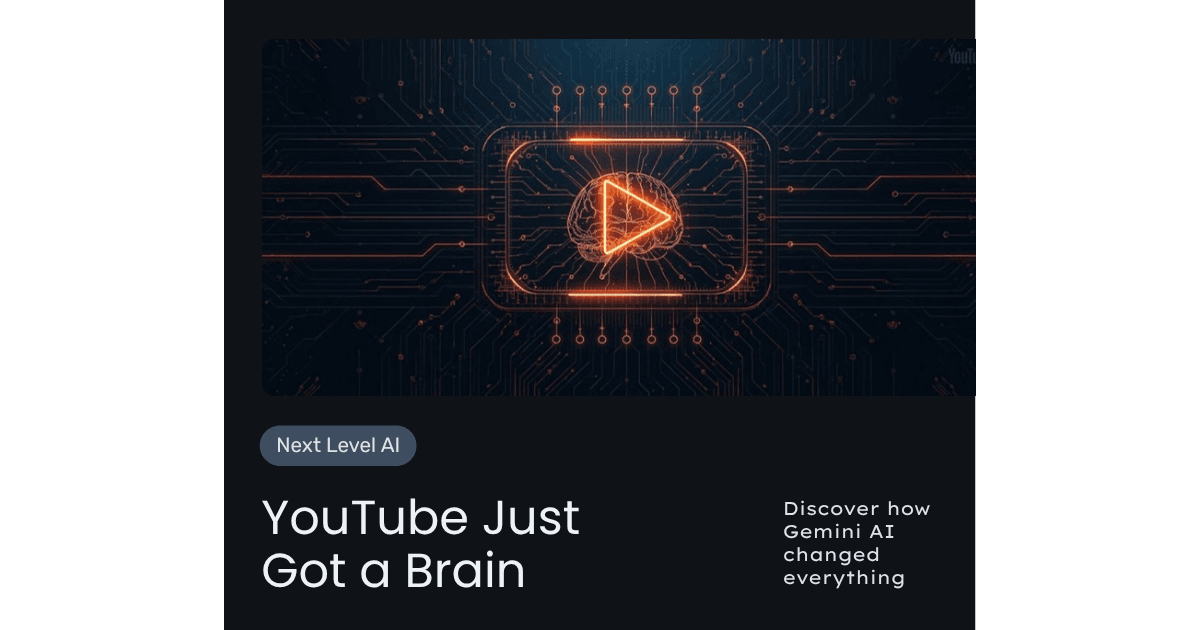
YouTube rewired its entire recommendation engine with Gemini AI in January 2026. Most coaches and agents haven't adapted. Here's the exact Content Engine Stack that beats the new algorithm — and how AI cuts production time from 4 hours to 45 minutes.
On January 14, 2026, YouTube rewired its entire recommendation engine with Gemini AI — the biggest algorithm shift since the platform replaced raw views with watch time back in 2012. Most coaches and business owners still don't know it happened. The ones who do are quietly building a massive advantage.
Here's what changed, why it matters, and exactly what system beats it.
What Changed on January 14, 2026
YouTube's Gemini AI update is not a minor tweak. Here's what's fundamentally different:
- Tags are no longer your primary ranking signal. Gemini watches your video frame-by-frame — audio, visuals, tone, intent — and creates a "semantic ID" of your content's energy and purpose.
- Cross-platform signals are now factored in. Gemini pulls from a viewer's Gmail, Google Search history, and Drive activity to predict what they need right now, not just what they clicked last week.
- Shorts run on a completely separate algorithm. A Short's performance no longer affects your long-form video metrics. They are two independent growth channels requiring two distinct strategies.
- The 30-day freshness window is real. The algorithm actively deprioritizes Shorts older than approximately 30 days. Consistent posting is no longer optional — it is algorithmic law.
According to a detailed analysis of the Gemini update, the algorithm now evaluates "viewer satisfaction" over raw watch time — tracking repeat viewing, survey responses, and session continuation to determine which channels get recommended.
The bottom line: you cannot tag your way to discovery anymore. The algorithm watches how your content performs for actual humans and recommends you to more of them when it performs well.
The Stat That Changes the Conversation
In 2025, 73% of buyers and sellers used YouTube as part of their home or business search (Realtor.com, Oct 2025). That number is climbing. And yet most coaches are still treating YouTube like a hobby — posting when inspired, cutting videos short, wondering why the algorithm ignores them.
YouTube Shorts are averaging 200 billion daily views with a 5.91% engagement rate — one of the highest of any content format on any platform. And the biggest names in the space — Graham Stephan (5.15M subs), Ryan Serhant (1.48M), Meet Kevin (2.05M) — have no active Shorts strategy. That lane is wide open.
Why Most Coaches Are Losing the Algorithm Game
The typical coach content cycle looks like this: get inspired → film → spend 3–4 hours editing → post → see modest results → get busy → don't post for two weeks → algorithm deprioritizes the channel → repeat.
This is not a content problem. It is a systems problem.
The algorithm rewards channels that feed it consistently. A burst of content followed by silence is worse than a slow steady drip. And with Shorts now requiring a minimum of 5 posts per week to maintain algorithmic momentum, sporadic posting doesn't just underperform — it actively signals to Gemini that your channel isn't worth recommending.
The Content Engine Stack: One Video, Eight Assets
The system that beats the algorithm isn't about volume. It's about leverage. Here's how one cornerstone video per week generates everything else:
- 1 long-form video (10–18 minutes) — the cornerstone. Teaches a complete framework, answers a specific question, or documents a real result. This is what converts viewers to followers and followers to clients.
- 3 Shorts clipped from the cornerstone — using OpusClip, your long-form video auto-clips into Shorts in minutes. Each Short is a standalone insight.
- 1 newsletter section — pull the core insight and write it up for your email list. Link back to the full video. Your subscribers become your most loyal viewers.
- 1 community post — ask your community members to apply the framework from the video. This drives engagement and surfaces content ideas for the following week.
Result: 8 pieces of content from one recording session. The algorithm sees consistent activity across multiple formats. Gemini trains on your Shorts and starts recommending you to the exact audience searching your topics.
The AI Weapon: From 3–4 Hours to 45 Minutes
The biggest objection coaches have to this system is time. Here's how AI eliminates it:
| Task | Old Way | With AI |
|---|---|---|
| Clip long-form into Shorts | Manual editing (60–90 min) | OpusClip (5 min) |
| Thumbnail creation | Canva manual (30 min) | Canva AI (2 min) |
| Caption writing | Manual (20 min) | Claude (2 min) |
| Content calendar | Brainstorm (60 min) | One Claude prompt (5 min) |
| Total per video | 3–4 hours | ~45 minutes |
The prompt that generates two weeks of content in 60 seconds:
"I'm a [niche] coach. Create a two-week YouTube content calendar with: 2 long-form video ideas (10–18 min), 15 Short ideas across 5 formats (insight, stat, myth bust, tip, story), and a Mon–Fri posting schedule. Write the hook for each Short."
Works in Claude, ChatGPT, or Gemini. Copy it. Use it tomorrow.
The Team Math
If you lead a team, the numbers compound fast:
| Team Size | Min Shorts/Week | Goal Shorts/Week | Monthly Content |
|---|---|---|---|
| Solo | 5 | 15 | 60–240 pieces |
| Team of 5 | 25 | 75 | 300–1,200 pieces |
| Team of 10 | 50 | 150 | 600–2,400 pieces |
At goal, a team of 10 produces 640 pieces of content per month feeding the algorithm — without anyone spending more than 45 minutes a day on content.
The Window Is Open. It Won't Stay Open.
The top channels haven't figured out Shorts yet. The algorithm just got smarter. AI makes production faster than you can make excuses. And 73% of your market is already on YouTube waiting to find you.
The question is not whether YouTube works in 2026. The data is settled. The question is whether you build the system first — or wish you had.
Ready to build your Content Engine? Join us inside Systems Over Hustle — where coaches are running this exact system together.

Written by
Aaron CuhaAuthor of Crazy Simple YouTube, keynote speaker, and executive coach with 20,000+ hours logged. ICF PCC, NLP Master Practitioner, and DISC Certified. Aaron helps entrepreneurs replace hustle with AI-powered systems that generate leads, content, and revenue on autopilot.