Creating content manually is a losing game. Here is how to build an AI-powered content engine that turns one core piece of content into a month of distribution across every platform.
If you are still creating every piece of content from scratch, you are working 10 times harder than you need to. The entrepreneurs and coaches I work with used to spend 20 to 30 hours per week on content creation. Now they spend 3 to 5 hours producing one core piece of content, and their AI content engine handles the rest — transforming that single recording into blog posts, social media updates, email newsletters, short-form clips, and quote graphics automatically.
This is not about replacing creativity with robots. It is about using AI to handle the repetitive transformation work so you can focus on what only you can do: bring original thinking and expertise to the table. After building content engines for dozens of coaches and business owners through our AI systems practice, I have refined a process that anyone can implement.
What Is an AI Content Engine?
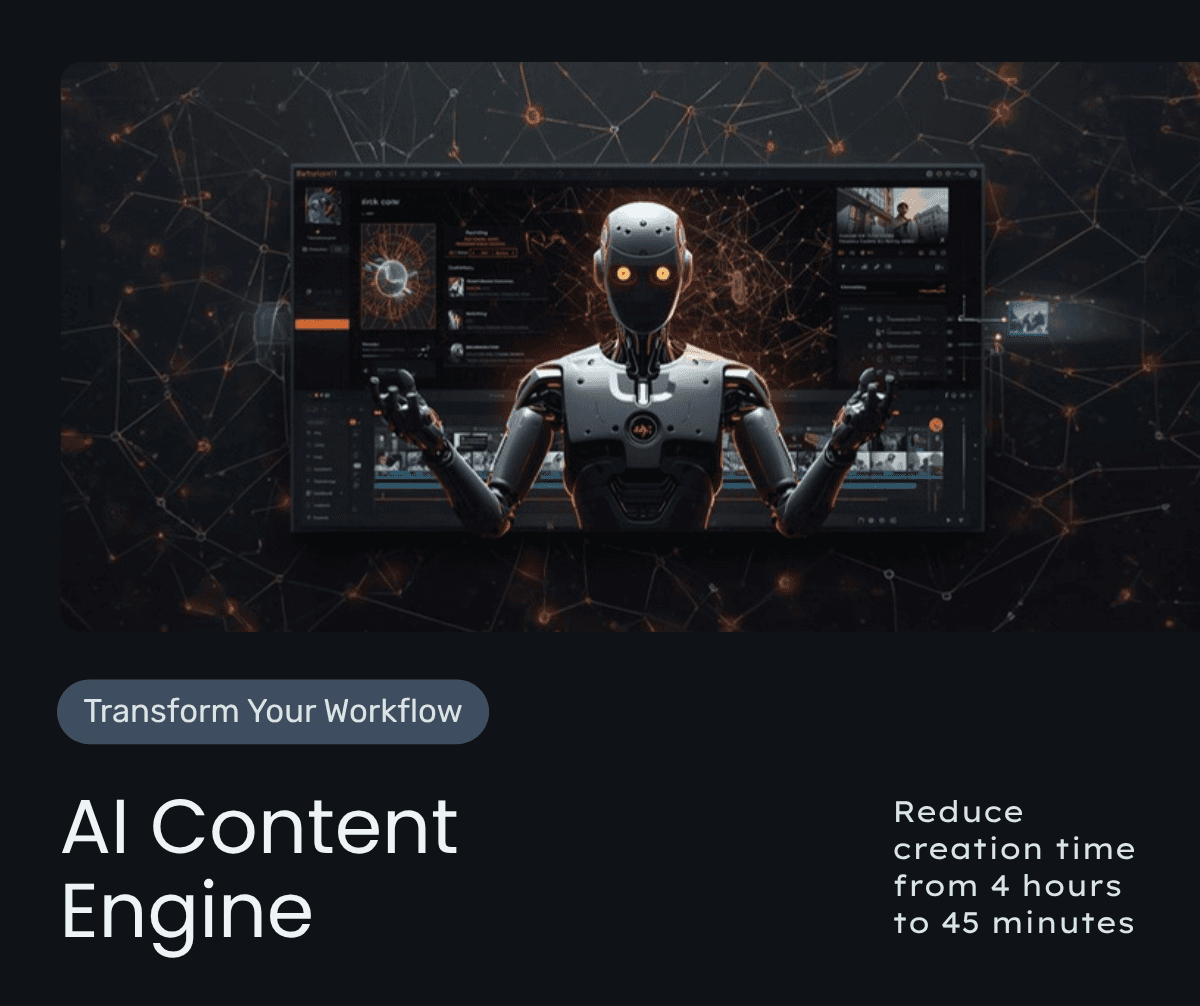
An AI content engine is a system of connected tools and workflows that takes a single piece of long-form content — typically a YouTube video or podcast episode — and automatically transforms it into multiple content formats for different platforms. It is the Authority Flywheel concept, supercharged by AI.
Here is what a fully built content engine produces from one 30-minute YouTube video:
- A 1,500-word blog post optimized for SEO
- 5 to 8 short-form video clips (60 to 90 seconds each) for Shorts, Reels, and TikTok
- 10 to 15 social media posts (LinkedIn, X, Facebook)
- 1 email newsletter issue
- 3 to 5 quote graphics for Instagram and Pinterest
- A Twitter/X thread summarizing key points
- Show notes with timestamps and key takeaways
That is 25 to 35 pieces of content from one recording session. Manually, this would take 15 to 20 hours. With an AI content engine, it takes under 60 minutes of review and approval time.

Step 1: Create One Exceptional Core Piece
The engine only works if the input is strong. Garbage in, garbage out — this applies to AI content just as much as anything else. Your core content piece should be:
- Deeply educational. Teach something specific and actionable. Surface-level content produces surface-level derivatives.
- Structured with clear sections. Use distinct teaching points, stories, and frameworks. This gives the AI clear segments to transform into standalone pieces.
- Optimized for your primary platform. If your core platform is YouTube, make the video excellent on its own merits first. The content engine amplifies what is already good — it cannot fix what is mediocre.
I recommend YouTube as your core platform because video contains the richest information: visual, audio, and textual. A 30-minute video has more raw material for transformation than a 30-minute audio podcast or a 2,000-word blog post. For guidance on creating strong YouTube content, read my YouTube SEO guide.
Step 2: Build Your AI Tools Stack
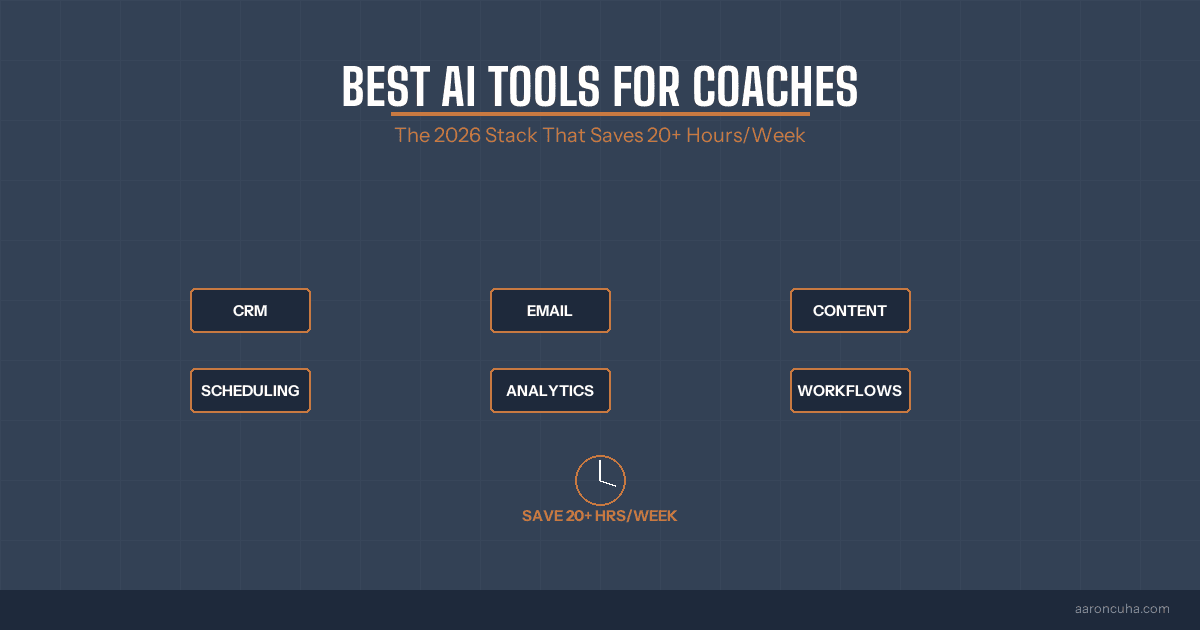
Here is the exact stack I recommend for coaches and business owners in 2026:
Transcription and Processing
Descript or Otter.ai for automated transcription. Both produce accurate transcripts with speaker identification. The transcript becomes the foundation that your AI tools work from.
Written Content Generation
Claude (Anthropic) or GPT-4 for transforming transcripts into blog posts, social media copy, email content, and show notes. I prefer Claude for longer-form content because it maintains coherence and voice better across long outputs. The key is creating custom prompts that match your brand voice — more on this in Step 3.
Short-Form Video Clipping
Opus Clip or Vizard.ai for automatically identifying the most engaging moments in your long-form video and clipping them into vertical short-form content. These tools use AI to detect high-engagement moments, add captions, and format for each platform.
Visual Content
Canva with Magic Design for generating quote graphics, carousel posts, and promotional images from your content. Canva's AI features can generate on-brand visuals from text prompts drawn from your transcript.
Workflow Automation
Make.com to connect all these tools into an automated pipeline. When you upload a new video, Make.com triggers the transcription, feeds the transcript to your AI writing prompts, generates clips, creates graphics, and queues everything for your review. Learn more about building these automations in my AI automation guide.
Step 3: Train Your AI on Your Voice
The number one complaint about AI-generated content is that it sounds generic. That is because most people use default prompts. The fix is building custom prompt templates trained on your specific voice, vocabulary, and communication style.
Here is how to create a brand voice prompt:
- Gather 10 to 15 examples of your best content. Blog posts, social media updates, emails — anything where your authentic voice shines through.
- Feed them to Claude or GPT-4 and ask it to analyze your writing style. Prompt: "Analyze these writing samples and describe the author's voice, tone, vocabulary patterns, sentence structure preferences, and communication style in detail."
- Use the analysis to build a system prompt. Every AI content generation task starts with this system prompt that tells the AI how to write like you.
- Iterate and refine. The first outputs will be 70 to 80 percent accurate to your voice. Review, provide feedback, and adjust the prompt until outputs consistently sound like you wrote them.
Step 4: Build the Automated Workflow
Here is the workflow I set up for my clients, step by step:
- Record and upload your core video. You handle this — it requires your unique expertise and presence.
- Auto-transcription triggers. Make.com detects the new upload and sends it to Descript for transcription.
- AI writing pipeline. The transcript feeds into your custom AI prompts, generating a blog post draft, 10 social media posts, an email newsletter draft, and show notes.
- Short-form clip generation. Simultaneously, Opus Clip processes the video and generates 5 to 8 short-form clips with captions.
- Visual content generation. Key quotes from the transcript feed into Canva templates to generate quote graphics.
- Review queue. All generated content lands in a single review dashboard (I use Notion or Airtable) where you review, approve, or edit before publishing.
- Scheduled publishing. Approved content auto-publishes through Buffer, Hootsuite, or native platform scheduling.
The entire pipeline from video upload to review queue takes under 30 minutes. Your review and approval time is another 30 to 60 minutes. Total time investment: 1 to 2 hours for 25 to 35 pieces of platform-specific content.
Step 5: Quality Control Is Non-Negotiable
AI content engines are force multipliers, not replacements for human judgment. Every piece of content should pass through your review before publishing. Here is what I check:
- Accuracy. Did the AI represent your ideas correctly? AI can hallucinate or misinterpret nuance.
- Voice. Does it sound like you? If something reads as generic AI-speak, rewrite it or adjust your prompt.
- Platform fit. A LinkedIn post has different conventions than an Instagram caption. Make sure each piece fits its destination.
- Call to action. Every piece should lead somewhere — your YouTube channel, your website, your booking page, your book.
The goal is not autopilot publishing. It is assisted publishing — AI does the heavy lifting, you provide the quality filter. As your prompts improve, the review step gets faster. Most of my clients reach a point where 90 percent of AI-generated content needs only minor tweaks.
What to Expect: Realistic Results
Here is what a typical coaching client sees after implementing an AI content engine:
- Content output: 4x to 8x increase in publishing frequency across platforms
- Time savings: 12 to 18 hours per week reclaimed from manual content creation
- Consistency: Daily presence on social media without daily effort
- SEO growth: 3x more indexed pages driving organic search traffic within 6 months
- Lead generation: 30 to 50 percent increase in inbound inquiries due to increased visibility
These results compound. More content means more visibility. More visibility means more leads. More leads mean more clients. And it all starts with one recording session per week. If you want to build your own AI content engine, book a strategy call and I will design the workflow for your specific business.
Frequently Asked Questions
Will AI-generated content hurt my brand authenticity?
Not if you train the AI on your voice and review everything before publishing. The content should be AI-assisted, not AI-produced. Your ideas, frameworks, and expertise are the core — AI handles the transformation and formatting.
How much does an AI content engine cost to build?
Software costs range from $100 to $500 per month depending on your tools. Descript ($24/month), Claude API ($20 to $50/month for typical usage), Make.com ($29/month), and Opus Clip ($19/month) are the core expenses. This is a fraction of what you would pay a content team.
Can I use AI content for SEO?
Yes, as long as the content is high-quality, original in perspective, and provides genuine value. Google's stance is that AI-assisted content is fine — the quality of the content matters, not how it was produced. Always add unique insights and edit for depth.

Written by
Aaron CuhaAuthor of Crazy Simple YouTube, keynote speaker, and executive coach with 20,000+ hours logged. ICF PCC, NLP Master Practitioner, and DISC Certified. Aaron helps entrepreneurs replace hustle with AI-powered systems that generate leads, content, and revenue on autopilot.