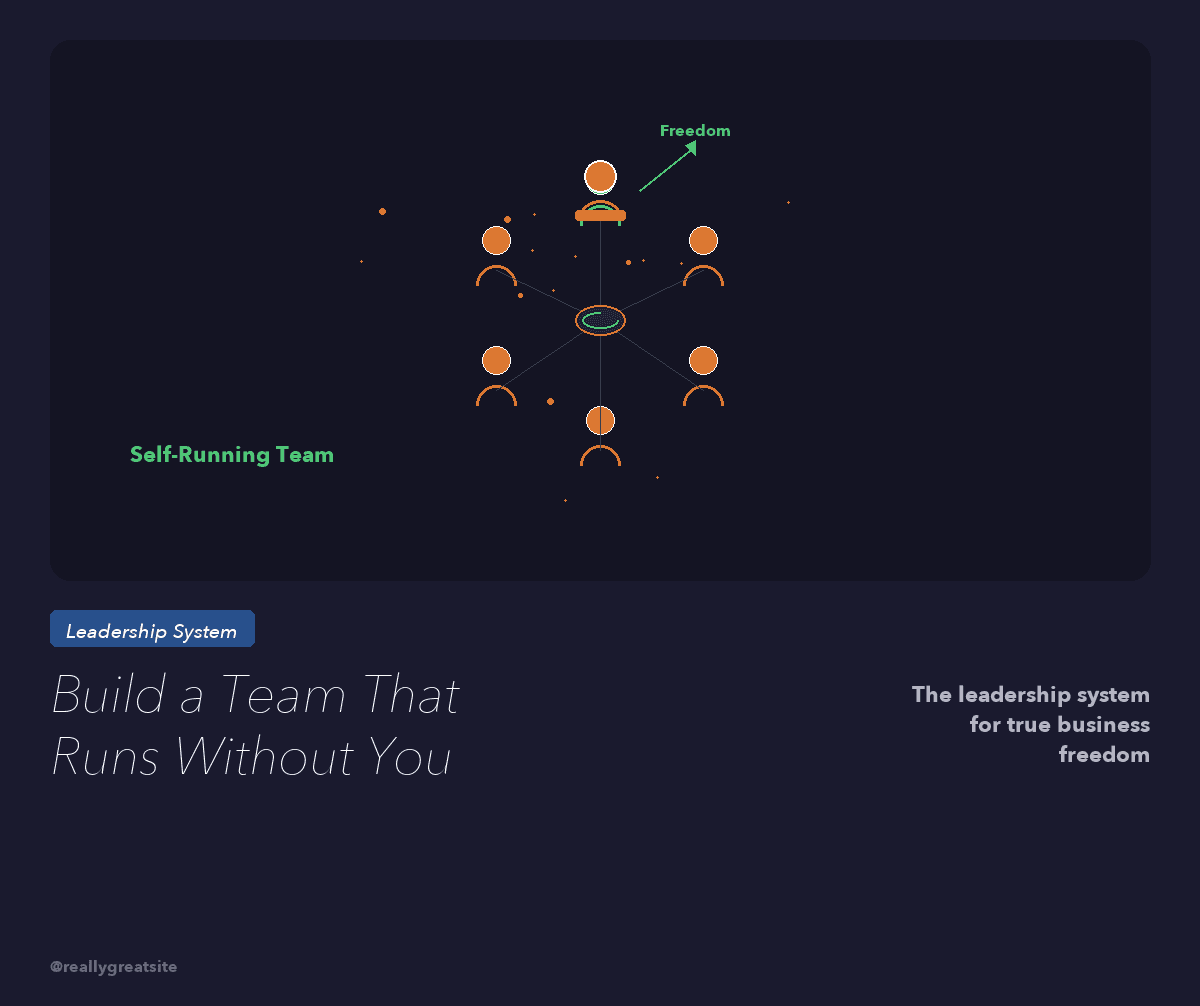
You did not start a business to be chained to every decision. Here is the 4-step framework I used to build teams across 280 offices that operated without me in the room.
If you want to build a team that runs without you, you have to stop being the answer to every question. I learned this the hard way. When I was scaling DirectLender to 280 offices and 3,000 employees, I hit a wall that every entrepreneur hits: I was the bottleneck. Every decision, every escalation, every "quick question" ran through me. I was working 80-hour weeks and the business could not grow past what I could personally touch. According to Harvard Business Review, 73 percent of leaders report being the primary bottleneck in their organization, and most do not realize it until growth stalls.
The fix was not working harder. It was building systems that made me irrelevant to daily operations. That framework is what I teach every client inside executive coaching, and it is the reason my clients consistently 3-5x their revenue while cutting their working hours in half.
Key Takeaways
- The 4-step framework: Hire for Systems, Build the Delegation OS, Install KPI Dashboards, Remove Yourself Systematically
- Most founders are the bottleneck because they hire for talent instead of systems-fit
- A proper delegation framework eliminates 80 percent of founder decisions within 90 days
- KPIs must be leading indicators, not lagging ones — track inputs, not just outputs
- The goal is not to step away forever — it is to choose where you spend your time
Tired of being the bottleneck in your business? Let me show you exactly where to start.
Book a Strategy SessionWhy Founders Stay Stuck as the Bottleneck
Here is the uncomfortable truth: most founders stay stuck because they are addicted to being needed. It feels productive. It feels important. But it is the single biggest threat to your business. If your team cannot function for two weeks without you, you do not own a business — you own a job with extra liability.
I see three patterns that keep founders trapped:
- The Hero Complex: You believe nobody can do it as well as you. Maybe that was true when you had three employees. At 15, 50, or 200, it is a delusion that kills growth.
- No Documented Systems: The "how" of your business lives in your head. When someone has a question, you are the only source of truth. That makes you a single point of failure.
- Hiring for Talent, Not Fit: You chase rock stars instead of hiring people who thrive inside structured systems. Rock stars need freedom. Systems-driven teams need clarity.
A Gallup study found that organizations with clear role expectations and documented processes see 21 percent higher profitability and 41 percent lower absenteeism. Systems are not bureaucracy. They are the foundation of team autonomy.

Step 1: Hire for Systems, Not Just Talent
The first step to building a team that runs without you is changing how you hire. Stop looking for people who "figure things out." Start looking for people who execute documented systems with precision and improve them over time.
Here is my hiring framework:
- Define the system first. Before you write a job description, document the exact process this person will own. If you cannot document it, you are not ready to hire for it.
- Hire for process discipline. In interviews, I ask candidates to walk me through how they completed a repetitive task at their last job. I want to hear words like "checklist," "SOP," "workflow." If they say "I just figured it out as I went," that is a red flag.
- Test with a paid trial. Give finalists a 5-day paid trial where they execute your documented system. You are not testing whether they are smart — you are testing whether they follow systems and flag problems proactively.
- Onboard with documentation, not shadowing. If your onboarding process is "follow me around for two weeks," your systems are broken. New hires should be able to start executing within 48 hours using your documented processes.
When I built the team at DirectLender, we could onboard a new loan officer and have them productive within five business days. Not because they were geniuses — because the system was that clear. I teach this same onboarding methodology inside real estate coaching and it consistently cuts ramp time by 60 percent.
Step 2: Build the Delegation Operating System
Delegation is not dumping tasks on someone and hoping for the best. It is a structured operating system with five layers. I call it the Delegation OS, and it is the single most valuable system I have ever built for clients.
The five layers:
- Level 1 — Inform: "Do this and tell me when it is done." No decision-making required. Example: send the weekly newsletter using this template.
- Level 2 — Research: "Investigate and give me options." They do the legwork, you make the call. Example: find three vendors for our new CRM and present a comparison.
- Level 3 — Recommend: "Investigate, recommend a path, and wait for my approval." Example: review our ad spend and recommend budget reallocation.
- Level 4 — Decide and Report: "Make the call and tell me what you did." They have authority to act. Example: handle client escalations under $1,000.
- Level 5 — Full Ownership: "Own this entirely. Only bring me exceptions." Example: run the hiring process end-to-end for junior roles.
Most founders keep everything at Level 1 or 2. That is why they are buried. The goal is to move every repeatable function to Level 4 or 5 within six months. I walk through this exact system with clients inside our Systems Over Hustle community — with templates, examples, and weekly accountability.
Want the Delegation OS templates? Join 500+ entrepreneurs inside the community.
Book a Strategy SessionHere is a practical test: write down every decision you made last week. Categorize each one by delegation level. If more than 20 percent of your decisions are Level 1 or 2 tasks, you are doing work that someone else should own. According to McKinsey, executives who delegate effectively spend 23 percent more time on strategic work and generate 33 percent higher team output.
Step 3: Install KPI Dashboards That Drive Behavior
You cannot manage what you do not measure. But here is where most entrepreneurs get KPIs wrong: they track lagging indicators. Revenue. Profit. Close rate. Those numbers tell you what already happened. They are the rearview mirror.
What you need are leading indicators — the inputs that predict outcomes. Here is the difference:
- Lagging: We closed $200K in revenue this month. (What happened.)
- Leading: We made 150 outbound calls, booked 45 meetings, and sent 30 proposals this week. (What is about to happen.)
When your team tracks leading indicators daily, they self-correct before problems become crises. They do not need you to tell them they are off track — the dashboard tells them.
My KPI dashboard framework has three tiers:
- Daily Pulse Metrics: 2-3 numbers each team member tracks every single day. For a sales team, that is calls made, conversations had, and appointments booked. For a content team, that is pieces published, engagement rate, and leads generated.
- Weekly Scorecard: Roll up the daily metrics into a weekly scorecard that the team reviews in a 15-minute Monday meeting. No narratives. Just numbers. Red, yellow, or green.
- Monthly Strategic Review: This is where you look at trends, identify systemic issues, and adjust strategy. This is the only meeting that requires your presence as the founder.
When I implemented this at DirectLender, manager escalations dropped 67 percent in the first quarter. Teams started solving their own problems because they could see them in the data before they became emergencies. I cover dashboard setup in detail for service businesses inside real estate coaching.
Step 4: Remove Yourself Systematically
This is where founders panic. Removing yourself does not mean abandoning your team. It means choosing where you invest your time based on highest impact, not highest urgency.
Here is the systematic removal process I use with coaching clients:
- Weeks 1-4: Document every task you do for 30 days. Every email, meeting, decision, phone call. You will be shocked at how much of your time goes to Level 1 and 2 tasks.
- Weeks 5-8: Transfer 50 percent of your tasks using the Delegation OS levels. Start with the easiest, lowest-risk functions. Give your team written SOPs and clear authority.
- Weeks 9-12: Transfer another 30 percent. You should now be down to strategic work only: vision, key relationships, product decisions, and team development.
- Month 4+: Take a two-week vacation. Seriously. Do not check email. Do not jump on Slack. This is the stress test. If the business stumbles, you know exactly which systems need strengthening.
One of my coaching clients — a real estate team leader running a $15M GCI team — followed this exact timeline. By month four, she took three weeks off for the first time in nine years. Her team closed $1.2M in GCI while she was gone. Not because she hired superstars. Because the systems were that good.
The 5 Mistakes That Kill Team Autonomy
I have coached hundreds of entrepreneurs through this framework. Here are the five mistakes I see destroy progress:
- Re-doing delegated work. If you hand something off and then redo it yourself, you have just taught your team that their work does not matter. Give feedback, do not take over.
- No decision-making authority. If every decision still needs your sign-off, you have not delegated — you have just added a middleman. Push authority down.
- Skipping the documentation step. Verbal delegation is gambling. Written SOPs are systems. Every single process needs to be documented before it is delegated.
- Measuring activity instead of outcomes. "Are they busy?" is the wrong question. "Are they hitting their KPIs?" is the right one. Activity without outcomes is motion without progress.
- Hiring before systemizing. If you hire before documenting the process, the new hire will create their own process. Now you have inconsistency instead of scale.
A SHRM study found that 58 percent of new hires who fail do so because of poor onboarding systems, not lack of capability. The system determines the outcome, not the individual.
Building a Culture of Ownership, Not Compliance
The ultimate goal is not a team that follows instructions. It is a team that owns outcomes. Compliance cultures produce employees who do exactly what is asked — nothing more, nothing less. Ownership cultures produce people who see a problem and fix it before you even know it exists.
Three things create ownership culture:
- Transparent metrics. When the team can see the same numbers you see, they make better decisions. Hide nothing. Share the scorecard with everyone.
- Decision-making authority at the edge. The person closest to the problem should have the authority to solve it. Your job is to set guardrails, not micromanage solutions.
- Public recognition for system improvement. When someone identifies a broken process and fixes it, celebrate that loudly. You want a team that improves the machine, not just operates it.
Inside Systems Over Hustle, I share the exact weekly meeting agendas, scorecard templates, and delegation trackers I use with private coaching clients. The community includes founders running teams from 3 to 300 people, all working through this same framework together.
Ready to stop being the bottleneck? Let me audit your current team systems and show you where to start.
Book a Strategy SessionFrequently Asked Questions
How long does it take to build a team that runs without you?
With focused effort, most entrepreneurs can remove themselves from 80 percent of daily operations within 90 to 120 days. The key is following the systematic removal process — documenting, delegating, and stress-testing in phases rather than trying to hand everything off at once.
What if my team makes mistakes when I delegate?
They will. That is the cost of growth. The question is whether the mistakes are recoverable and whether the system catches them quickly. KPI dashboards and weekly scorecards surface problems before they become disasters. The alternative — doing everything yourself — is not sustainable.
Should I hire experienced people or train from scratch?
Hire for process discipline, not experience. An experienced person with bad habits is harder to retrain than a disciplined person who learns your system from day one. The paid trial I describe in Step 1 reveals this quickly.
How do I know which tasks to delegate first?
Start with the 30-day time audit. Then delegate the tasks that are high-frequency and low-complexity first — the ones that eat hours but do not require your expertise. Email management, scheduling, data entry, standard client communications. Save strategic tasks for last.
What tools do you recommend for KPI dashboards?
Keep it simple. A shared Google Sheet works for teams under 20. For larger teams, tools like Monday.com, ClickUp, or custom dashboards built with Google Looker Studio. The tool matters less than the discipline of checking it daily. I have seen teams scale to $10M using nothing but spreadsheets and Slack.
How do I maintain quality when I am not involved in every decision?
Quality comes from systems, not supervision. Build quality checkpoints into your SOPs — peer review steps, client feedback loops, and automated alerts for metric thresholds. If quality drops when you step away, the system is incomplete, not the team.
What is the biggest mistake founders make when building autonomous teams?
Re-doing delegated work. Every time you take back a task, you teach your team that their effort does not count. Instead, give specific feedback and let them redo it. It takes longer in the short term but builds capability that compounds over months.
Can this framework work for solopreneurs who are just starting to hire?
Absolutely. In fact, this is the best time to implement it. Document your systems before your first hire. When that person starts, they walk into a clear, structured role instead of figuring things out on the fly. Solopreneurs who systemize before scaling grow 2 to 3 times faster than those who hire and hope.

Written by
Aaron CuhaAuthor of Crazy Simple YouTube, keynote speaker, and executive coach with 20,000+ hours logged. ICF PCC, NLP Master Practitioner, and DISC Certified. Aaron helps entrepreneurs replace hustle with AI-powered systems that generate leads, content, and revenue on autopilot.