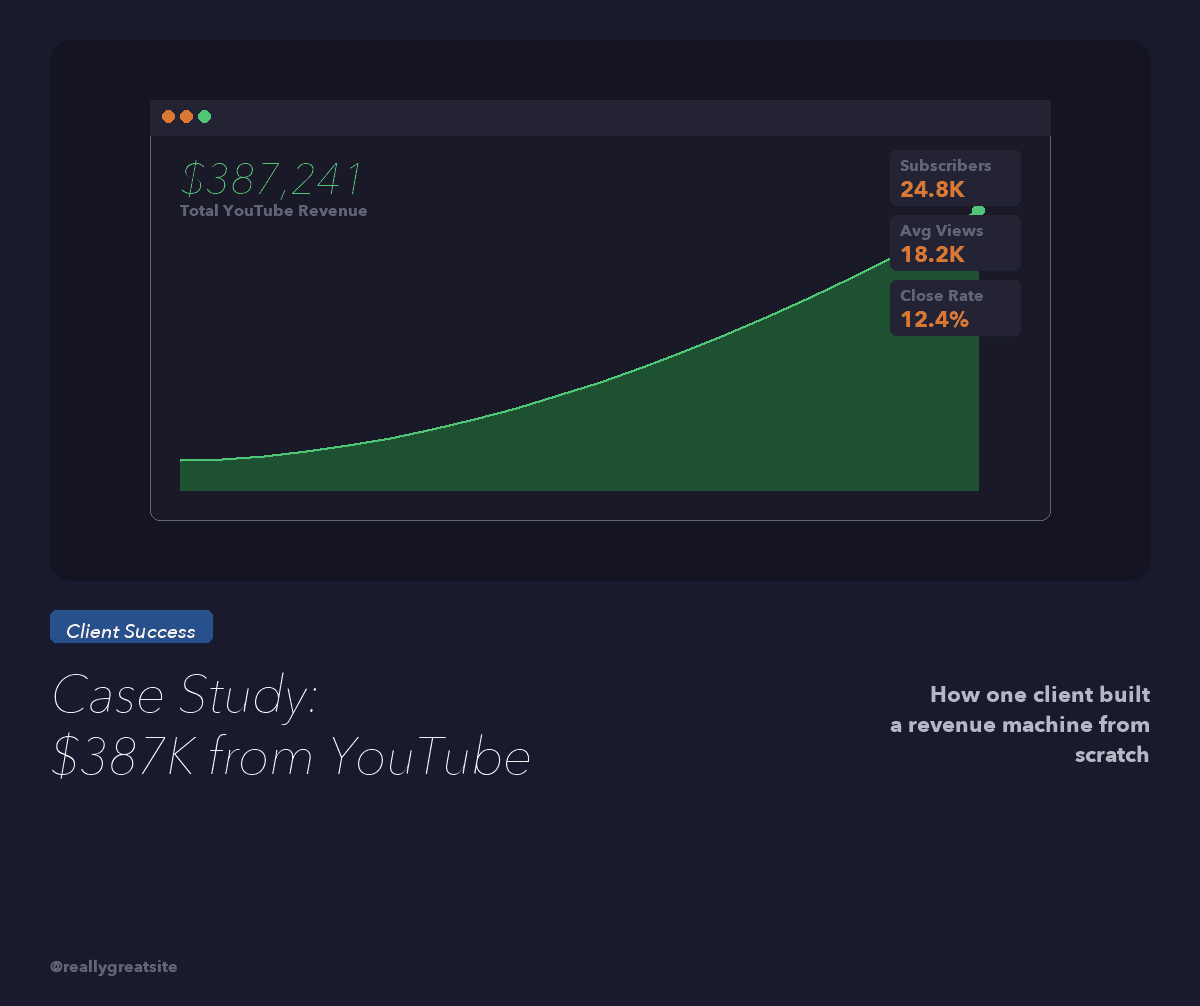
Marcus was a top-producing loan officer stuck on referrals. In 14 months, a YouTube system generated $387,000 in new commissions. Here is exactly what we built, why it worked, and how to replicate it.
This YouTube case study breaks down how Marcus, a mortgage loan officer in Phoenix, generated $387,000 in commissions from a single YouTube channel in 14 months. When he came to me, Marcus had zero videos, zero subscribers, and a business that lived and died on referral relationships. He was producing $1.2 million in annual volume but plateauing hard. Every quarter looked the same. By month 14 of running the system I am about to show you, he had closed 43 YouTube-sourced transactions worth $387,000 in gross commissions. This is not theory. This is what happened, step by step.
Key Takeaways
- Marcus went from zero YouTube presence to $387,000 in commissions in 14 months
- The system produced 43 closed transactions from YouTube-sourced leads
- He published just one video per week using the Content Anchor method
- His channel reached 4,200 subscribers — proving you do not need massive audiences to generate massive revenue
- The average cost per YouTube lead was $0 compared to $47 per lead from paid ads
Want to see if your business can replicate results like these? Get a personalized channel assessment.
Get Your Free YouTube AuditWhere Marcus Started: The Referral Ceiling
Marcus had been a loan officer for 11 years. Good reputation. Strong close rate. But he had a problem that plagues every referral-dependent professional: he could not control the flow. Some months he had 8 deals. Other months he had 2. His pipeline was a roller coaster dictated by real estate agents and past clients who may or may not remember to send someone his way.
He had tried paid ads on Facebook and Google. The results were mediocre — $47 per lead on average, with a 3 percent close rate. That math works, barely, but it is fragile. One algorithm change or cost spike and the model breaks. He needed an owned asset that generated inbound leads on autopilot.
That is when he found our YouTube strategy services. His exact words on our first call: "I know I should be on YouTube. I just have no idea what to say or how to make it work." That is the most common thing I hear. The gap is never talent or budget. It is always strategy.
The System: What We Built in the First 30 Days
We did not start by filming. We started by building the system. The first 30 days were entirely strategy and infrastructure. Here is what that looked like:
Week 1 — Niche positioning and keyword research. We mapped 147 keywords that Phoenix homebuyers were actively searching on YouTube. Not broad terms like "mortgage rates" that national channels dominate. Hyper-local terms: "FHA loans in Maricopa County," "Phoenix first-time buyer down payment assistance," "Arizona VA loan requirements." According to Ahrefs, long-tail YouTube keywords convert at 2.5 times the rate of head terms because the intent is more specific.
Week 2 — Content calendar and thumbnail-title testing. We pre-planned 12 weeks of content using the 80/20 system I teach in Crazy Simple YouTube. Every video had its thumbnail and title designed before a single frame was filmed. Eight search-driven videos. Four personality-driven videos. Each one mapped to a specific keyword cluster.
Week 3 — Production workflow and equipment setup. Marcus spent $340 total on equipment: a Rode wireless mic, a ring light, and a simple backdrop. No studio. No fancy camera. iPhone 15 Pro. We documented a 45-minute weekly production workflow: script review, film, upload. His editor (hired on Upwork for $15 per video) handled the rest.
Week 4 — Lead capture system. Every video funneled viewers to a free "Phoenix Homebuyer Checklist" landing page. The page collected name, email, phone, and purchase timeline. The follow-up sequence was 5 emails over 14 days, then a weekly nurture. This is the system I break down in my post on YouTube for business lead generation.

The First 90 Days: Building Momentum
Here is the honest truth about the first 90 days: they were slow. Marcus published 12 videos in that window. His best-performing video had 1,100 views. His worst had 47. Total subscriber count at day 90: 380. Most people would have quit. Marcus did not quit because we had set clear expectations from day one — YouTube is a compounding asset, not a slot machine.
But even with modest view counts, the leads started trickling in by week 6. His first YouTube lead came from a video titled "5 Things First-Time Buyers in Phoenix Need to Know in 2025." The viewer watched the video, clicked the checklist link, filled out the form, and booked a call. That one lead closed 45 days later — a $340,000 purchase with $4,200 in commission.
By day 90, Marcus had generated 14 leads from YouTube. Four were in active conversations. Two had submitted loan applications. The cost of those leads: zero dollars in ad spend. Just his time filming one video per week and $15 per video for editing. Compare that to his Facebook ad spend of $2,100 per month that was generating roughly the same number of leads.
According to Google's consumer insights, 68 percent of consumers say they have made a purchase decision after watching a brand's video. That number climbs to 82 percent for financial services when the video specifically addresses a pain point the viewer is experiencing. Marcus was publishing content that hit those pain points every single week.
Months 4 Through 8: The Compounding Effect
Something shifted around month 4. YouTube's algorithm started recommending Marcus's older videos to new viewers. His day-90 video on FHA loans suddenly jumped from 1,100 views to 6,400 views. A video about Arizona down payment assistance programs hit 11,000 views. The flywheel was spinning.
Ready to build your own YouTube lead generation system? Let me show you how.
Book a Strategy SessionHere are the numbers from months 4 through 8:
- Total videos published: 20 (still one per week, he took 2 weeks off)
- Total channel views: 87,000
- New subscribers: 1,900 (total: 2,280)
- Leads generated: 112
- Loan applications submitted: 34
- Closed transactions: 19
- Commission from YouTube leads: $161,000
The average view count per video climbed from 900 in months 1-3 to 4,350 in months 4-8. That is the compound effect of topical authority. YouTube recognized Marcus as the go-to channel for Phoenix mortgage content and started recommending him aggressively in that niche.
The other thing that happened: Marcus started getting recognized. Realtors at open houses would say, "Oh, you are the YouTube mortgage guy." That social proof created a secondary referral engine. His referral business actually increased by 22 percent because agents saw his videos and trusted his expertise before they ever spoke to him. I see this pattern repeatedly with clients — your personal brand on YouTube compounds in ways you cannot predict.
Months 9 Through 14: Scaling Without Burning Out
By month 9, Marcus had a decision to make: scale production or optimize what was already working. We chose optimization. Instead of publishing more videos, we focused on three things:
- Repurposing every video into 8 additional assets — LinkedIn posts, Instagram Reels, email content. This is the Authority Flywheel in action.
- Improving the lead capture funnel. We split-tested landing pages and increased conversion from 4.1 percent to 7.3 percent. That single change nearly doubled his lead flow without publishing a single extra video.
- Building an AI-assisted content workflow. We used AI tools to generate video scripts from keyword clusters, auto-create thumbnails, and write email sequences. His weekly time investment dropped from 3 hours to 90 minutes. Our AI automation services are built specifically for this kind of workflow optimization.
The results from months 9 through 14:
- Total videos published: 22
- Total channel views: 194,000
- New subscribers: 1,920 (total: 4,200)
- Leads generated: 247
- Closed transactions: 24
- Commission from YouTube leads: $226,000
Combined 14-month total: 43 closed transactions. $387,000 in commissions. 4,200 subscribers. And a library of 54 videos that continue to generate leads every single day without any additional effort. That is the power of an owned media asset.
The 5 Tactics That Made the Biggest Difference
Looking back at Marcus's results, five specific tactics drove the majority of his success:
1. Hyper-local keyword targeting. Every video targeted a keyword that included "Phoenix," "Arizona," "Maricopa County," or a specific city name. National mortgage channels could not compete on these terms because they lacked local relevance. According to Backlinko's YouTube ranking study, localized content faces 73 percent less competition than national terms in the same category.
2. The 60-second hook formula. Every video opened with a specific pattern: state the problem, preview the solution, establish credibility. "If you are buying your first home in Phoenix, you need to know about this down payment program that can save you $15,000. I have helped 200 buyers use this program, and I am going to walk you through exactly how it works." That hook template averaged 62 percent retention past the first minute.
3. One CTA per video, repeated three times. Marcus did not pitch his services. He offered a free checklist. Every video mentioned it at the 2-minute mark, the midpoint, and the end. Simple. Consistent. The lead magnet did the selling for him.
4. Consistent publishing schedule. Every Tuesday at 9 AM. No exceptions except planned breaks. His audience knew when to expect new content. YouTube's algorithm rewarded the predictability with better recommendation placement.
5. Speed to contact. When a lead filled out the checklist form, Marcus called within 15 minutes during business hours. His close rate on leads contacted within 15 minutes was 31 percent. Leads contacted after 24 hours had a 4 percent close rate. Speed is everything in lead conversion. Research from Harvard Business Review confirms that responding within 5 minutes makes you 100 times more likely to connect with a lead.
How to Replicate Marcus's Results
Marcus is not special. I say that with respect — he would agree. He is not a natural on camera. His production quality is good, not great. He does not have a media background. What he had was a system and the discipline to follow it.
If you want to replicate his results, here is the playbook:
- Map 50 to 100 hyper-local or hyper-niche keywords in your market. Use YouTube search suggestions and tools like TubeBuddy or vidIQ.
- Pre-plan 12 weeks of content using the 80/20 framework (80 percent search-driven, 20 percent personality).
- Design thumbnails and titles before filming. If the packaging is not compelling, kill the idea.
- Build a lead capture system with a valuable free resource and a 5-email follow-up sequence.
- Publish weekly on the same day and time. No exceptions for at least 90 days.
- Contact every lead within 15 minutes. Speed to contact is the single highest-leverage variable in your close rate.
- Review analytics weekly and adjust. Double down on videos that generate leads. Cut formats that do not. Read my YouTube analytics guide for the exact metrics to track.
You can find more case studies like Marcus's on our site, or if you want to see the full framework laid out step by step, grab a copy of Crazy Simple YouTube.
The math is simple. If you are in a business where one client is worth $3,000 to $10,000, you only need 3 to 5 YouTube-sourced clients per month to generate six figures in additional annual revenue. Marcus proved that is not just possible — it is repeatable with the right system.
Want me to build this exact system for your business? Let us map out your YouTube strategy together.
Book a Strategy SessionFrequently Asked Questions
How long did it take Marcus to get his first YouTube lead?
Marcus received his first YouTube-sourced lead at week 6 after publishing 6 videos. That lead closed 45 days later for a $4,200 commission. Most clients in our program see their first lead between weeks 4 and 10 depending on their niche competition and content quality.
How much did Marcus spend on YouTube production?
His total upfront equipment cost was $340 (microphone, ring light, backdrop). Ongoing costs were $15 per video for editing on Upwork. Over 14 months, his total production cost was approximately $1,150. His return was $387,000 — a 336x return on investment.
Does this strategy work for industries other than mortgage?
Absolutely. We have replicated similar results for real estate agents, financial advisors, coaches, consultants, lawyers, and e-commerce brands. The system works in any industry where your clients search for answers on YouTube before making a buying decision. Check out our full case study library for examples across industries.
How many subscribers do you need to generate leads from YouTube?
Marcus generated his first lead with fewer than 200 subscribers. Subscriber count is a vanity metric. What matters is whether your content targets the right keywords and includes a clear call to action with a valuable lead magnet. Some of our highest-earning clients have fewer than 2,000 subscribers.
What camera equipment do I need to start?
A smartphone made in the last 3 years, a $50 to $80 lavalier or wireless microphone, and decent lighting (natural window light or a $30 ring light). Marcus filmed every video on an iPhone 15 Pro. Production quality matters less than content quality and consistency.
Can I hire someone to run this system for me?
You need to be on camera — that is non-negotiable for personal brand channels. But everything else can be delegated: scripting, editing, thumbnail design, SEO optimization, lead magnet creation, and email sequence writing. Our YouTube strategy services include done-for-you implementation of the entire system.
What if my market is too competitive for YouTube?
If national competitors dominate broad keywords, go hyper-local or hyper-niche. Marcus did not try to rank for "mortgage rates." He ranked for "FHA loans Maricopa County." There is always an angle where you can own the conversation. That is exactly what we identify in a free YouTube audit.
How does this compare to running paid ads?
Marcus was spending $2,100 per month on Facebook ads generating leads at $47 each with a 3 percent close rate. His YouTube leads cost $0 in ad spend with an 11 percent close rate. The difference: YouTube leads watched 10 to 20 minutes of his content before reaching out. They were pre-sold. Paid ad leads had zero relationship with him. Both channels can work, but YouTube builds an asset that compounds over time while ad spend resets to zero every month.

Written by
Aaron CuhaAuthor of Crazy Simple YouTube, keynote speaker, and executive coach with 20,000+ hours logged. ICF PCC, NLP Master Practitioner, and DISC Certified. Aaron helps entrepreneurs replace hustle with AI-powered systems that generate leads, content, and revenue on autopilot.