Most entrepreneurs use the words coaching and mentoring interchangeably. That confusion costs them years of growth.
Executive coaching vs mentoring — most business owners treat these as the same thing, and that confusion costs them real money. After spending 15 years in both roles — mentoring founders informally and running structured executive coaching vs mentoring engagements through our executive coaching program — I can tell you the difference is not semantic. It is structural. And that structure determines whether you get vague encouragement or measurable business results.
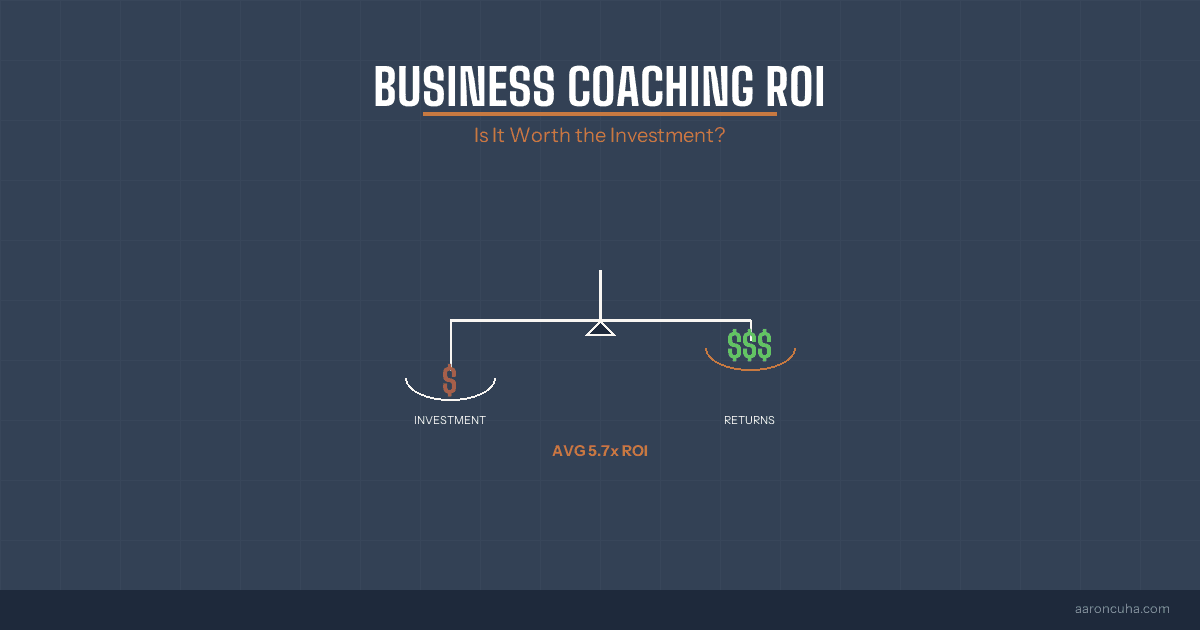
According to the International Coaching Federation's 2025 Global Study, companies that invest in structured executive coaching see a median ROI of 700 percent. Mentoring programs, while valuable, show significantly lower measurable returns — typically in the range of 20 to 30 percent productivity improvement. The gap is not about quality. It is about systems.
Key Takeaways
- Coaching is systems-driven with measurable outcomes — mentoring is relationship-driven with experiential guidance
- The best time for mentoring is years 0 to 2 of business — coaching becomes critical at the scaling stage
- Structured coaching produces 700 percent median ROI versus 20 to 30 percent from mentoring alone
- You do not have to choose — but you need to know which one solves your current bottleneck
- The biggest mistake is hiring a mentor when you need a coach, or vice versa
Not sure whether coaching or mentoring is the right next step? Let me diagnose your actual bottleneck.
Book a Strategy SessionThe Real Difference Between Coaching and Mentoring
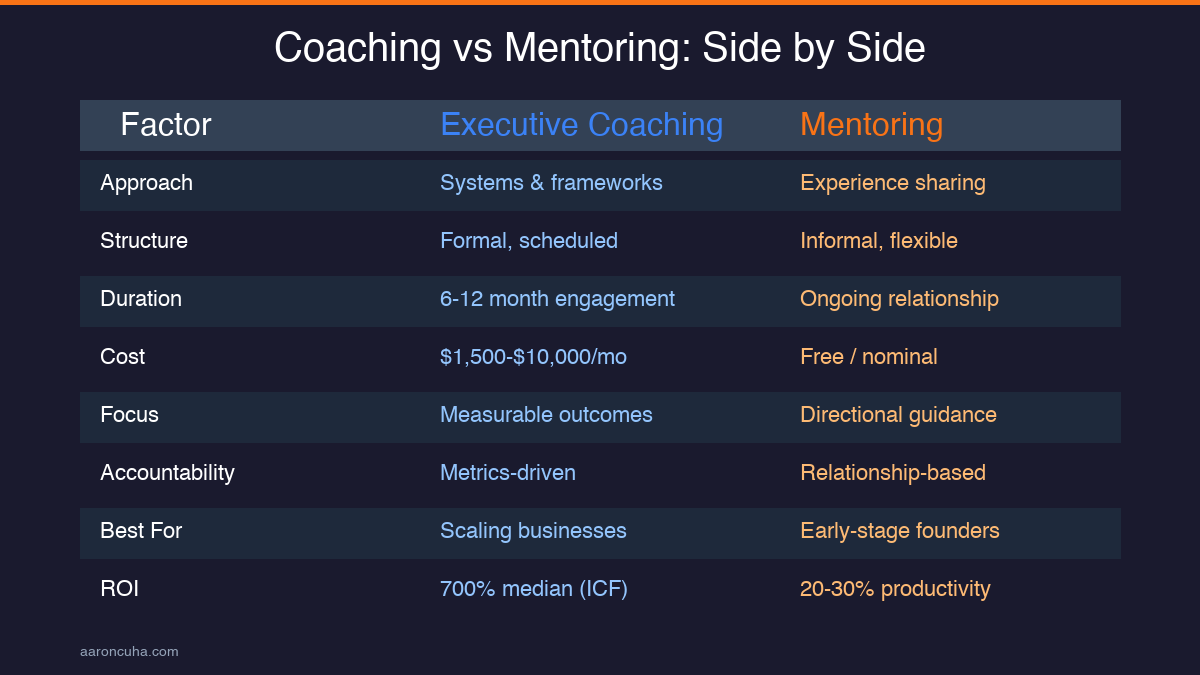
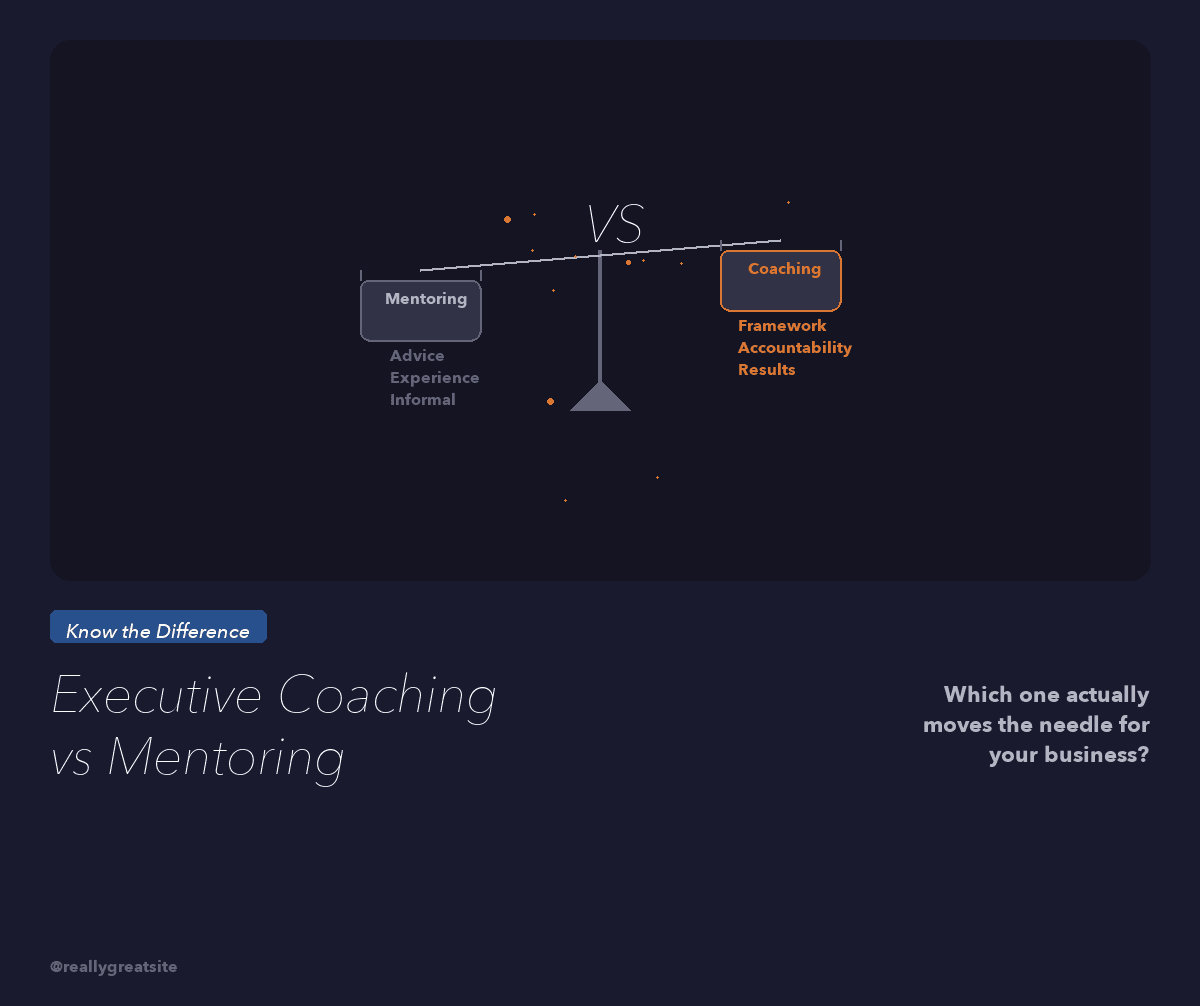
A mentor tells you what they did. A coach helps you build a system for what you need to do. That single-sentence distinction explains everything.
Mentoring is experience transfer. Your mentor has been where you are, made the mistakes, and can share the lessons. It is invaluable — especially early in your journey. The problem is that a mentor's experience is specific to their context, their market, their era, and their personality. What worked for them in 2015 may not work for you in 2026.
Coaching is framework transfer. A great executive coach does not tell you what to do. They give you systems, frameworks, and accountability structures that help you find and execute the right answer for your specific situation. The frameworks are transferable across industries and time periods because they are built on principles, not tactics.
Here is the analogy I use with clients: a mentor is like a friend who is a great cook and shares their favorite recipes. A coach is like a culinary instructor who teaches you how to develop recipes, manage a kitchen, and run a restaurant. Both are useful. But one scales and the other does not.
When Mentoring Is the Right Choice
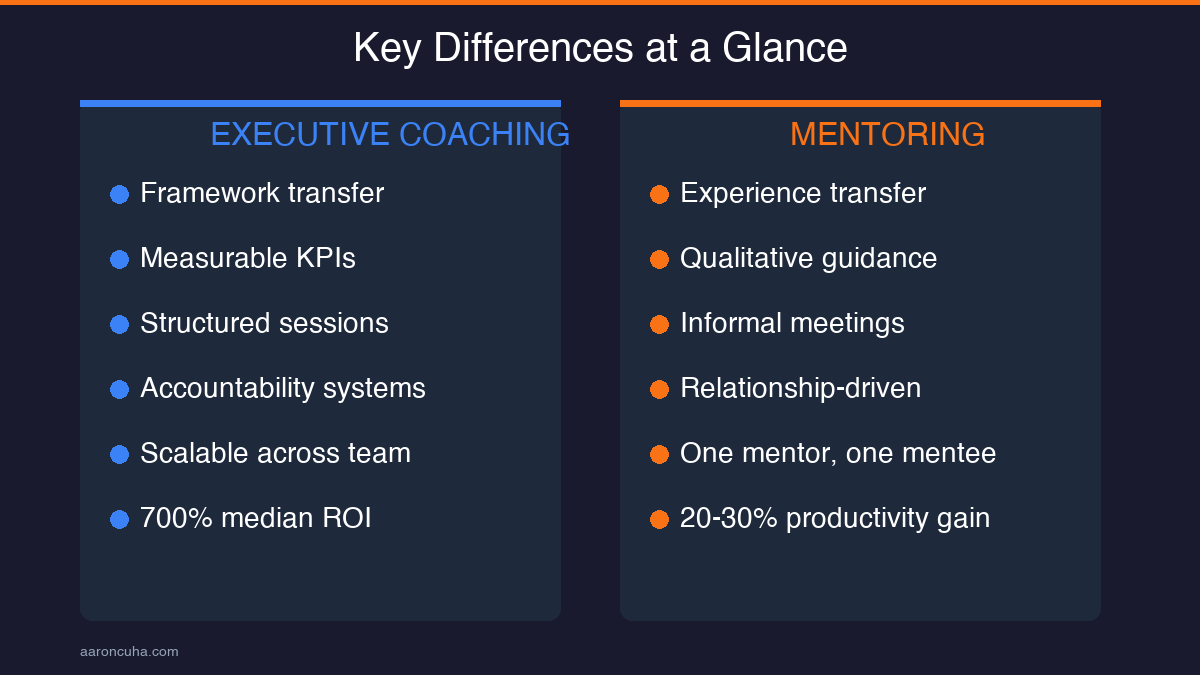
I am not anti-mentoring. I have had mentors who changed the trajectory of my life. Mentoring is the right choice in specific circumstances:
- You are in years 0 to 2 of business. At this stage, you do not know what you do not know. A mentor who has walked the path can help you avoid catastrophic early mistakes — the kind that kill businesses before they ever get off the ground.
- You are entering a new industry. Industry-specific knowledge — regulations, norms, key relationships — is best learned from someone who has lived it. No framework replaces knowing that a certain vendor is unreliable or that a specific regulation is about to change.
- You need emotional support and perspective. Entrepreneurship is isolating. A mentor who has been through the valleys can provide psychological safety and perspective that no framework can offer. According to Forbes Coaches Council, 76 percent of entrepreneurs report that having a mentor improved their mental resilience during difficult periods.
The limitation of mentoring is that it depends entirely on the mentor's availability, experience, and ability to translate their journey to your context. When it works, it is powerful. When it does not, you end up following someone else's playbook in the wrong game.
When Executive Coaching Actually Scales Your Business
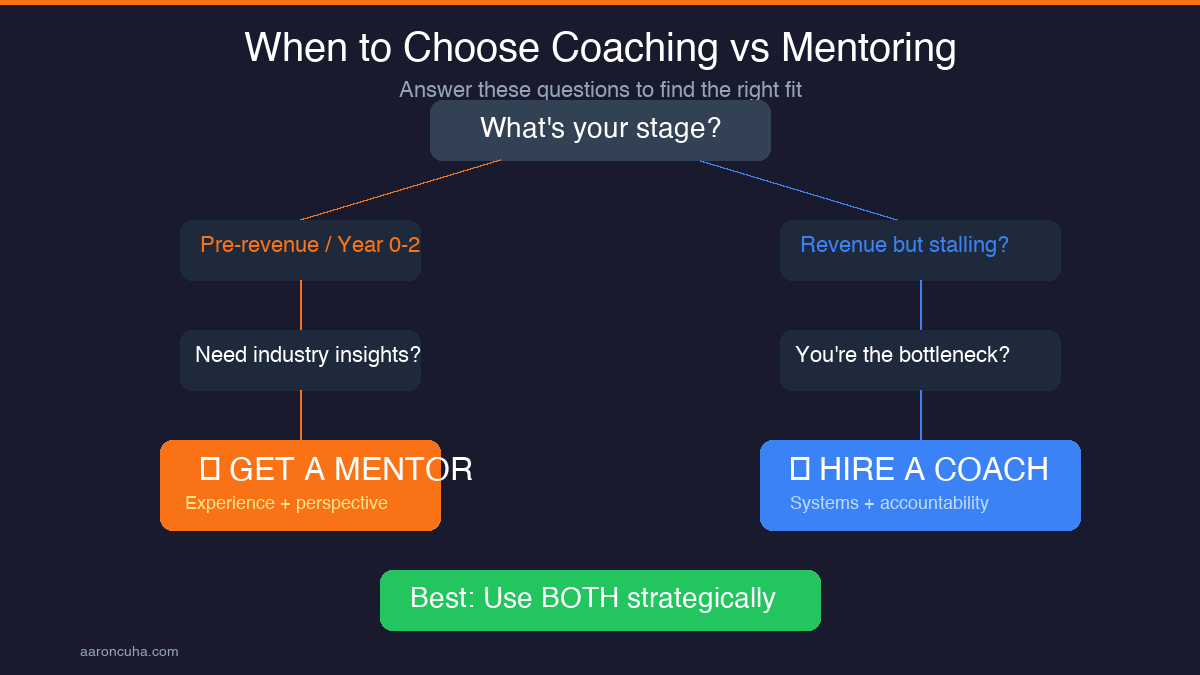
Coaching becomes critical at the scaling stage — when you have product-market fit, you have revenue, and the bottleneck is no longer "what do I do" but "how do I build systems so this works without me doing everything." That is the inflection point where most businesses stall.
I see this pattern constantly through our executive coaching practice. A founder hits $500K to $2M in revenue. They are working 70-hour weeks. They have tried hiring but keep getting burned. They have read all the books. They know what to do — they just cannot seem to execute at scale.
That is not a knowledge problem. It is a systems problem. And systems problems require a coach, not a mentor. A coach will help you:
- Build decision-making frameworks so you are not the bottleneck on every choice
- Install operational systems that produce consistent results regardless of who is executing
- Develop leadership capabilities so your team performs without constant oversight
- Create accountability structures that keep you focused on the 20 percent of activities that drive 80 percent of results
- Measure what matters — not vanity metrics, but the leading indicators that predict growth
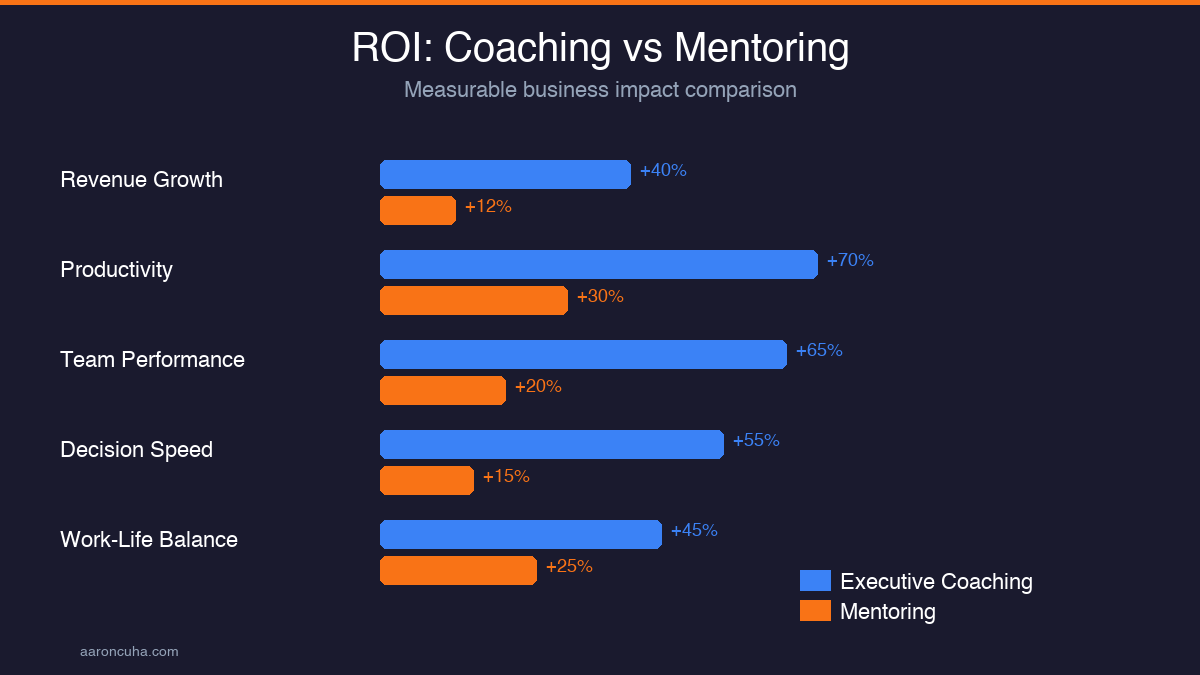
The data backs this up. A SHRM study found that executives who received structured coaching improved their performance by 70 percent, compared to 35 percent for those with mentoring alone. The difference is not the people — it is the structure.
Why Systems-Based Coaching Produces Measurable Results
Not all coaching is created equal. Plenty of coaches are essentially expensive cheerleaders — they ask open-ended questions, validate your feelings, and send you on your way. That is therapy, not coaching. I say that as someone who values therapy. But therapy and coaching solve different problems.
Systems-based coaching — what I practice and teach — starts with a premise: every business problem is a systems problem. If your sales are inconsistent, you do not have a sales problem — you have a sales system problem. If your team is underperforming, you do not have a people problem — you have a management system problem.
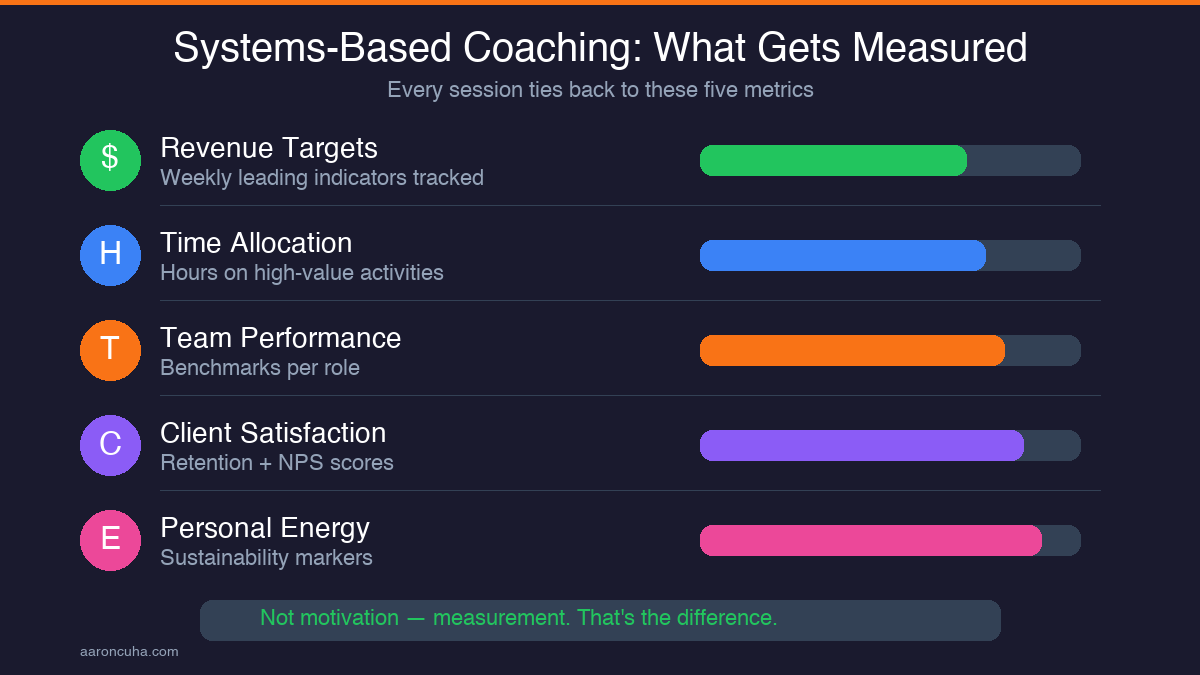
This approach produces measurable results because systems are measurable by definition. When I work with a client, we set specific metrics at the start of the engagement:
- Revenue targets with weekly leading indicators
- Time allocation goals — how many hours per week on high-value activities
- Team performance benchmarks
- Client satisfaction and retention metrics
- Personal energy and sustainability markers
Every session ties back to these metrics. We are not having abstract conversations about leadership philosophy. We are looking at data, identifying the bottleneck, and building or fixing the system that addresses it. I wrote about this approach in detail in Set in Stone — the idea that your business results should be as predictable as a well-built structure.
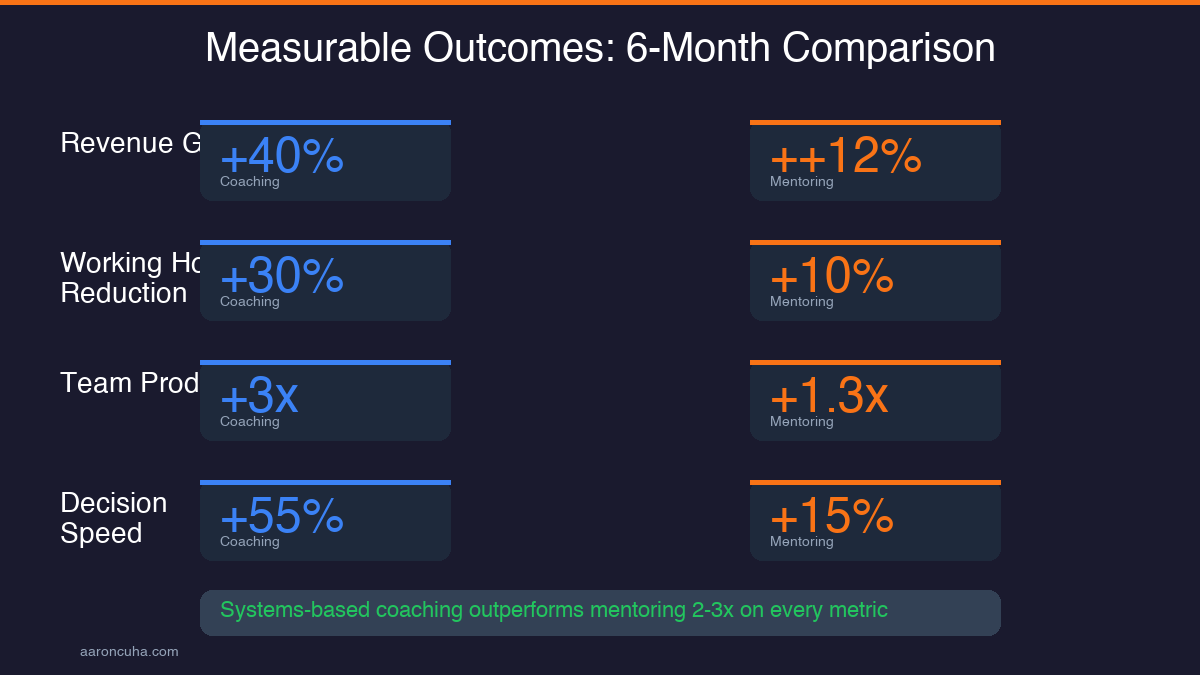
Our case studies show the results: clients averaging 40 percent revenue growth within six months, 30 percent reduction in working hours, and a 3x improvement in team productivity scores. Those numbers come from systems, not motivation.
See real results from systems-based executive coaching. Browse what other business owners have achieved.
Book a Strategy SessionThe Biggest Mistake: Hiring the Wrong One
The most expensive mistake I see business owners make is hiring a mentor when they need a coach, or hiring a coach when they need a mentor. Here is how to diagnose which one you need right now:
You need a mentor if:
- You are in a new industry and need insider knowledge
- You are pre-revenue or early-stage and need directional guidance
- You are facing an emotional or psychological challenge that requires perspective from someone who has been there
- You have a specific tactical question that experience can answer
You need a coach if:
- You know what to do but cannot seem to execute consistently
- Your business has hit a revenue ceiling you cannot break through
- You are the bottleneck — nothing happens without your involvement
- Your team is underperforming despite having capable people
- You are working more hours than you want with diminishing returns
If the second list resonates, the answer is executive coaching. Full stop. No amount of mentoring will solve a systems problem. A mentor can tell you to "hire better people" or "focus on what matters." A coach will help you build the hiring system, define the criteria, create the onboarding process, and install the accountability structure that makes good hires produce great results.
How to Use Both Without Wasting Money
The smartest entrepreneurs I know have both a mentor and a coach — but they use them for completely different purposes. Here is the framework I recommend:
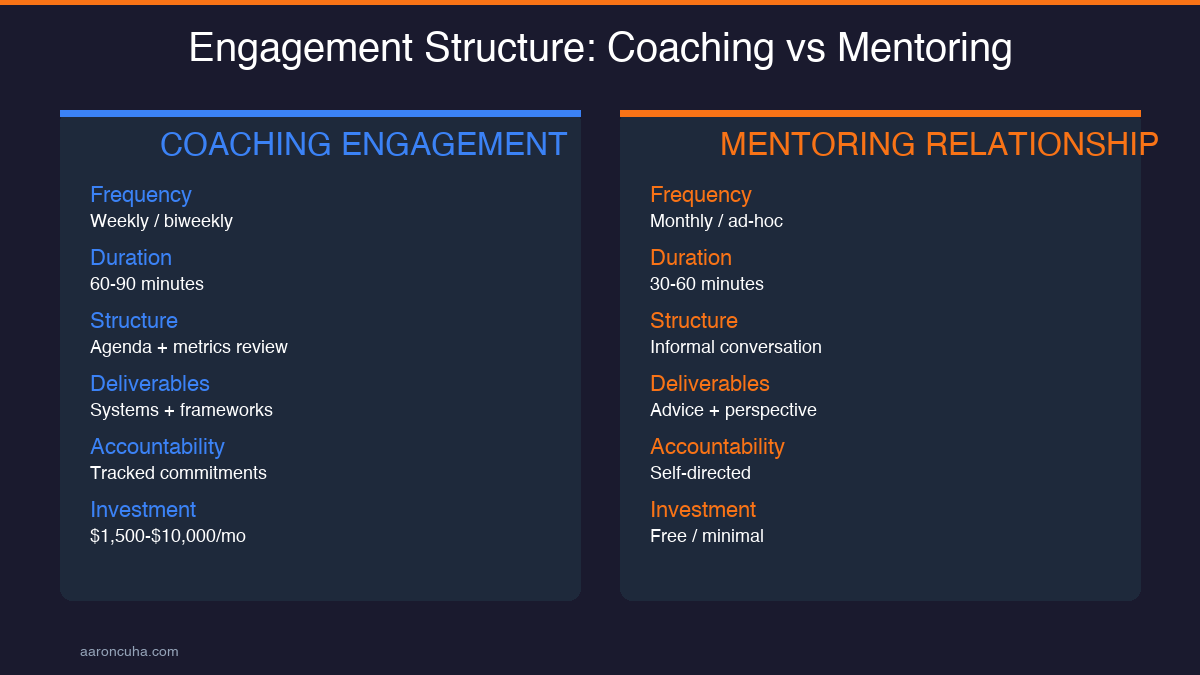
Monthly mentor conversations (informal, 30 to 60 minutes): Use these for big-picture perspective. Am I building the right business? Am I in the right market? How do I think about this major strategic decision? Your mentor's job is to share experience and offer perspective. No deliverables. No accountability metrics. Just wisdom transfer.
Weekly or biweekly coaching sessions (structured, 60 to 90 minutes): Use these for execution. What did I commit to last session? What got done? What did not? What system needs to be built or fixed? Your coach's job is to hold you accountable, diagnose bottlenecks, and provide frameworks. Every session ends with specific commitments and metrics.
The cost difference matters too. Mentoring should be free or nearly free — it is a relationship, not a transaction. Executive coaching is an investment, typically $1,500 to $10,000 per month depending on the level. But the ROI on structured coaching is clear and measurable. You should be able to trace every dollar spent on coaching to specific business outcomes within 90 days. If you cannot, you have the wrong coach.
Join our Systems Over Hustle community where we discuss coaching frameworks, leadership systems, and business scaling strategies weekly.
The Bottom Line
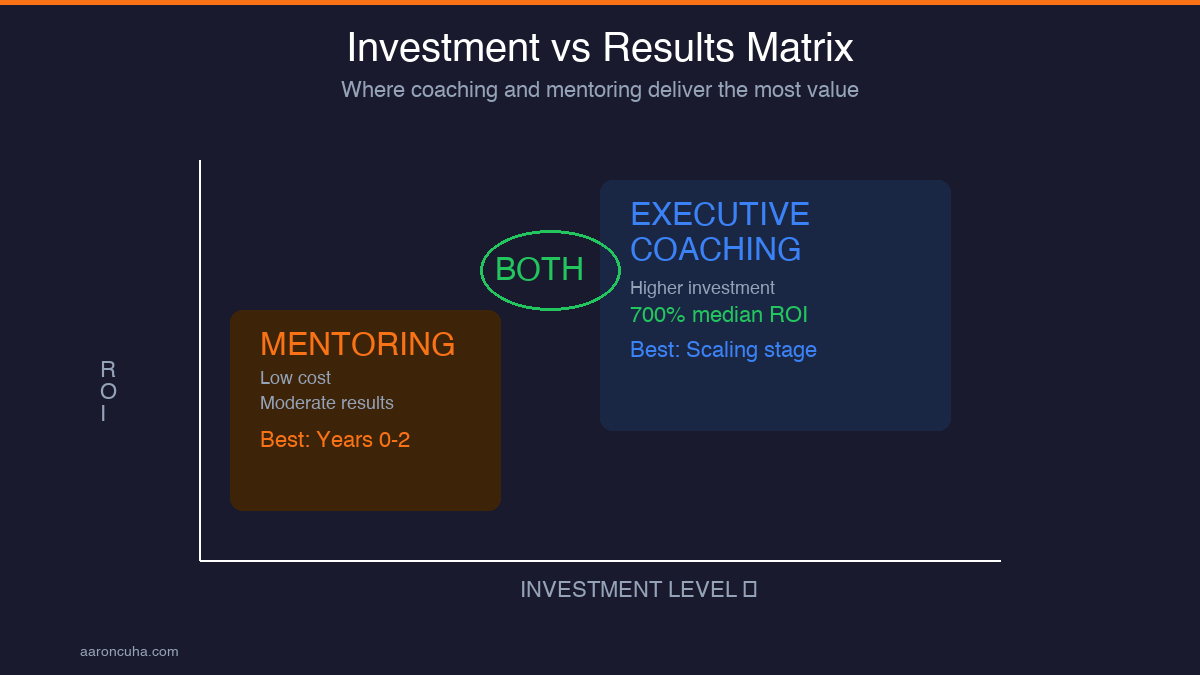
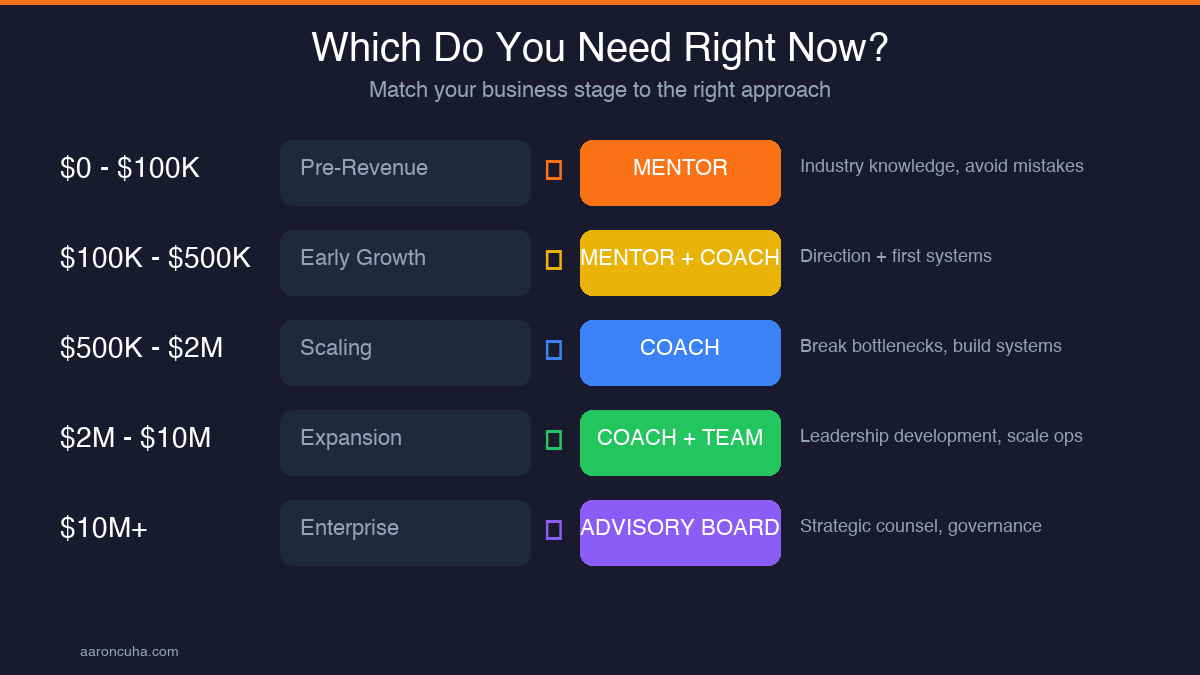
Executive coaching vs mentoring is not an either-or question. It is a sequencing question. Early stage, lean on mentors. Scaling stage, invest in coaching. And always prioritize systems-based coaching over motivational coaching — the kind that gives you frameworks, holds you to metrics, and produces results you can measure in revenue, not just feelings.
The entrepreneurs who scale fastest are the ones who stop asking "what should I do?" and start asking "what system do I need to build?" That shift — from tactics to systems — is what great coaching produces. It is the core of everything I teach through our executive coaching services and in Set in Stone.
If your business has hit a ceiling and you are not sure whether you need a mentor, a coach, or both — book a strategy call. I will tell you honestly which one solves your current bottleneck. No pitch. Just a diagnosis.
Ready to break through your revenue ceiling with systems-based executive coaching?
Book a Strategy SessionFrequently Asked Questions
What is the main difference between executive coaching and mentoring?
Coaching is systems-driven and produces measurable outcomes through frameworks, accountability, and metrics. Mentoring is relationship-driven and provides experiential guidance based on the mentor's personal journey. Both are valuable, but they solve different problems.
How much does executive coaching cost?
Executive coaching typically ranges from $1,500 to $10,000 per month depending on the coach's experience and the engagement structure. The median ROI is 700 percent according to the International Coaching Federation, making it one of the highest-return investments a business owner can make.
When should I hire an executive coach?
The ideal time is when your business has product-market fit and revenue, but you have hit a scaling bottleneck. Common signs: you are working 60-plus hours per week, you are the bottleneck on every decision, your team underperforms without your direct involvement, or revenue has plateaued despite your effort increasing.
Can mentoring alone scale my business?
Mentoring can help you avoid early-stage mistakes and provide valuable perspective, but it rarely provides the systems and accountability structures needed to scale. Most businesses that stall between $500K and $2M in revenue need structured coaching, not more advice.
How do I find a good executive coach?
Look for coaches who lead with systems and metrics, not motivation. Ask for specific client outcomes with numbers. A great coach should be able to show you measurable results from past clients — revenue growth, time savings, team performance improvements. If they cannot, keep looking.
How long does an executive coaching engagement typically last?
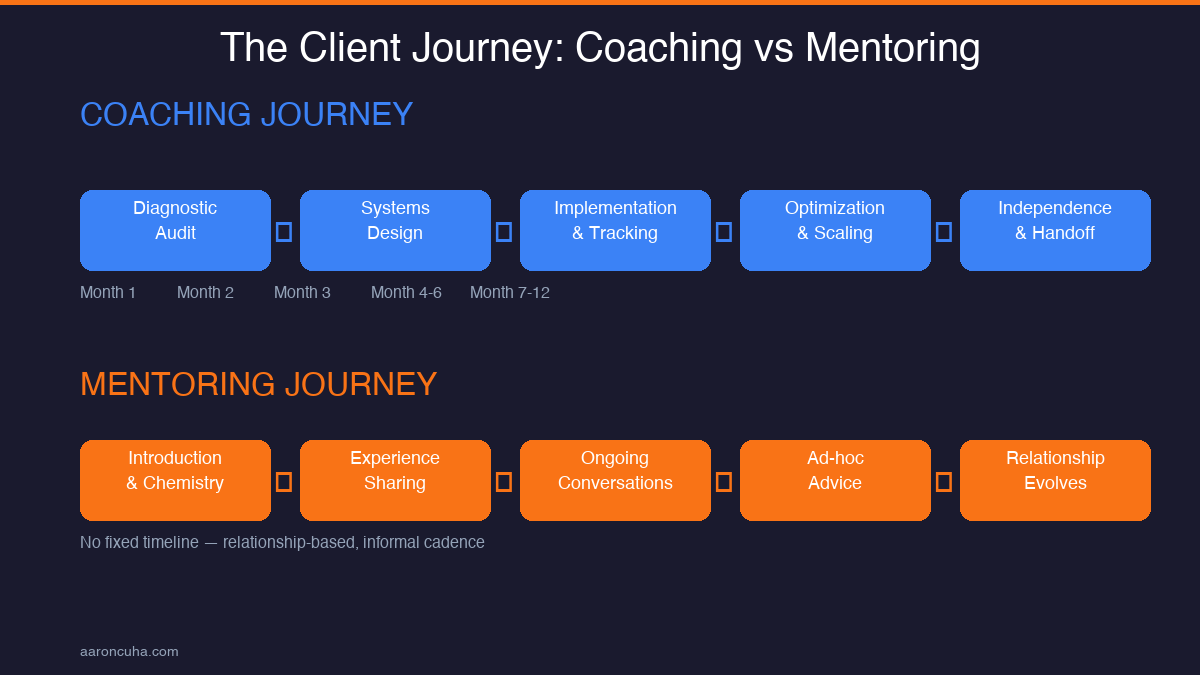
Most structured engagements run 6 to 12 months. The first 90 days focus on diagnosing bottlenecks and installing foundational systems. Months 4 through 6 focus on optimization and team development. Months 7 through 12 focus on scaling and sustainability. Results should be measurable by month 3.
Is group coaching as effective as one-on-one executive coaching?
Group coaching and one-on-one coaching serve different purposes. Group coaching is excellent for peer accountability, shared learning, and lower cost access to frameworks. One-on-one coaching is necessary for deep, personalized systems work specific to your business. I covered this in detail in my post on executive coaching vs group coaching.
What results should I expect from executive coaching in the first 90 days?
Within 90 days of systems-based coaching, you should see: a clear diagnostic of your business bottlenecks, 2 to 3 core operational systems installed, a measurable reduction in your working hours, and early indicators of revenue growth. If you do not see tangible progress by day 90, the coaching engagement is not working.

Written by
Aaron CuhaAuthor of Crazy Simple YouTube, keynote speaker, and executive coach with 20,000+ hours logged. ICF PCC, NLP Master Practitioner, and DISC Certified. Aaron helps entrepreneurs replace hustle with AI-powered systems that generate leads, content, and revenue on autopilot.